China
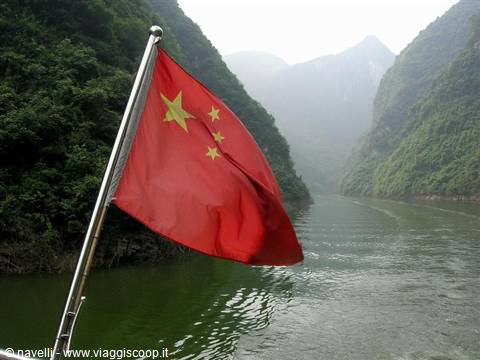
After so much waiting and so much hope, at last my husband Maurizio and I manage to fulfil our dream of visiting China by camper. After almost a month of travelling with stops along the way, the visit to Moscow and the crossing of Kazakhstan, on 13 May we spot the red flag with 5 stars of China and, extremely excited, we present ourselves at the border. Intimidated by the dozens of guards in perfect green uniform and cap with a red stripe who make us endless signs, we line up to stamp our passports and we notice, with extreme amazement, the cordiality and helpfulness shown to us. Although it is already late, in fact, they don't shut the counters in our faces, but rather they bend over backwards to make our crossing easier. The journey resumes the next day, once all the formalities are completed, under the protective wing of our guide Dieci.
We arrive at Urumqi, after crossing several small towns and spending the night in some of them, to stop for a couple of days. We thus have the chance to take part in the daily life of the Chinese, extremely busy and always smiling. We realise that they work enormously, from morning until 10 at night, without days off and with one day of rest a month! The city streets are one after another of small shops with brightly coloured signs almost bigger than the shop itself. The little restaurants are everywhere and in China, as in Italy, you can always find a little spot to stop and eat at any hour of the day or night.
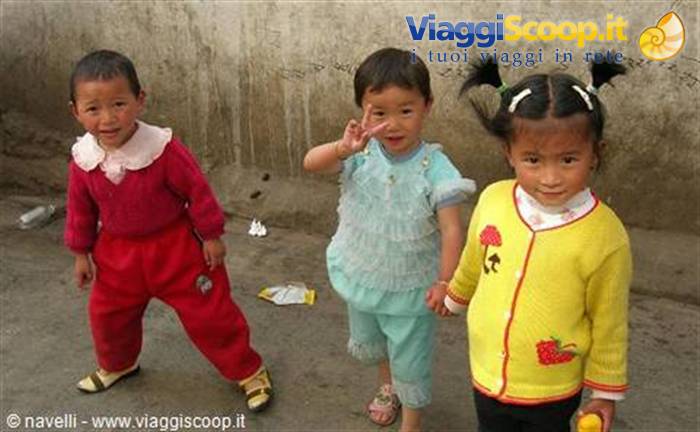
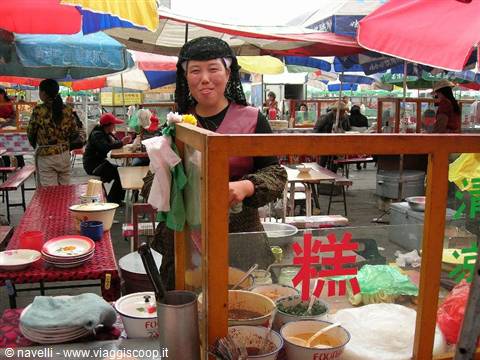
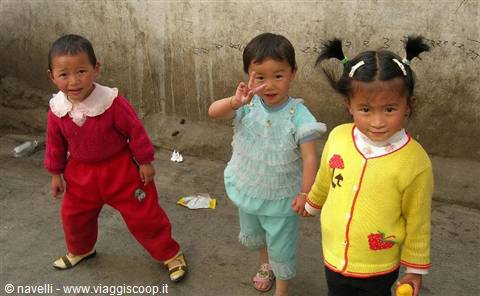
The only problem is the quality of the food which for us is too spicy! The markets too are open continuously morning and afternoon and the goods on display, divided by sections, are very plentiful, and range from mobile phones, to clothing, to fruit, to vegetables, to meat and fish. You don't find bread, but in this area where there is a very strong presence of Uyghurs, an ethnic group of Turkish origin, you find a kind of exquisite bread, baked in pit ovens. Milk too is found in the shops and lots and lots of toilet paper which is even used in restaurants in place of napkins! Another peculiarity that makes us think is that for small children neither pushchairs nor prams are used, but they are always carried in arms and moreover they wear no nappies and not even little pants, but shorts with the crotch open.
The journey continues crossing a desert area and it really feels like being in Tunisia with luxuriant oases in the distance where vines are grown and not so much to make wine, but to dry the bunches in special drying sheds placed outside the towns and obtain, together with melons and plums, dried fruit which is the main source of income of the area. We stop for a couple of days in Dunhuang where we visit the "Singing Sand Dunes" and, on roads some still under construction, others beautiful with toll booths every 100 kilometres, we head towards Tibet. We cross beautiful almost uninhabited areas and begin to climb in altitude. The last stop, before tackling the only road that leads to Lhasa, we make at Golmud.
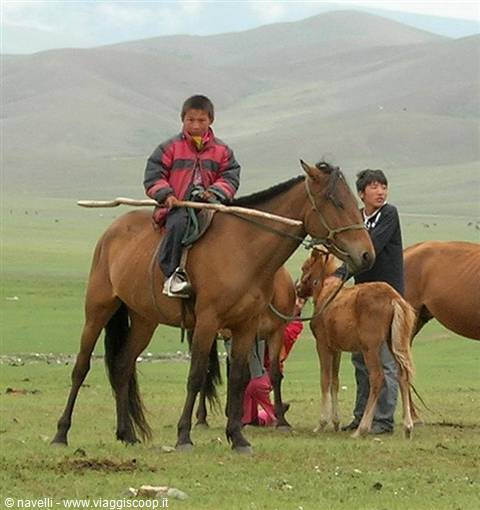
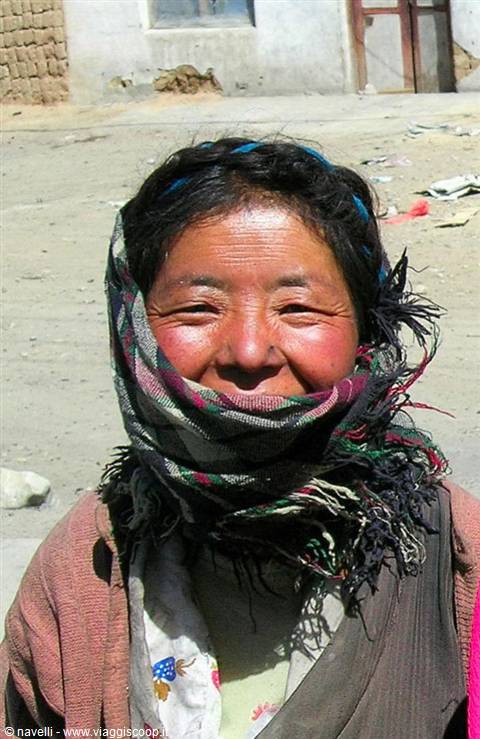
Then we set off and, skirting the railway under construction of about 1160 kilometres, we venture onto the Tibetan plateaus crossing beautiful prairies surrounded, in the distance, by mountains just sprinkled with snow and dotted with great herds of yak grazing peacefully. We pass through tiny villages nestled at the sides of the road, salt flats and, in a desert absolutely devoid of trees, we climb to the Kunlun pass of 4849 metres and, subsequently to the Tansguza pass of 5231 metres, suffering, obviously, from mountain sickness. Finally, after four days, we descend to Lhasa where we immerse ourselves in a life of other times full of mysticism and folklore. Almost everyone wears traditional clothes and hairstyles. Beautiful are those of the Khauipa men and women with silver rings and red ribbons woven into their raven hair.
The city, nestled beneath the majestic Potala, winter residence and government centre of the Dalai Lama, is full of pilgrims who, on foot, go to visit the Buddhist temple of Jokhang, the holiest in Tibet. With regret at not having been able to stay longer, we leave Lhasa to head for the famous three gorges of the Yangtze crossing a part of China untouched by international tourism. We pass through villages and towns of a few million inhabitants, but also through endless countryside where every square centimetre of land, even if it be earth moved by a landslide, is cultivated with such great care that it looks like a painting. The road, on the other hand, is used to dry fruit and vegetables, to thresh wheat and for other household activities. We arrive at Xi'an where we visit the Muslim quarter with a beautiful mosque and the eighth wonder of the world: the terracotta warriors.
Thousands of life-size statues and a beautiful museum housed in purpose-built structures. In muggy heat we arrive at Fengje from where we set off for a short cruise on the Yangtze River. The water of the dam has already risen by 100 metres so of the three beautiful gorges with their steep walls almost nothing remains. In 2009 it will rise for the last 75 metres and about 9 million people will be evacuated. We continue the journey in the mountainous part of China with a stop at Shaolin famous for its kung fu schools, also crossing vast and stupendous terraced rice fields, until we arrive at Shanghai.
The city welcomes us with its lively daily life and presents itself in the ideal combination of old and new: beneath the ultra-modern skyscrapers of concrete and glass, the working-class neighbourhoods with low houses and a myriad of activities from dining, to souvenirs for tourists, from little shops stuck one to the other to flea markets. For those like us who have never seen the great American cities, Shanghai suggests the idea of an ultra-modern metropolis. Obviously there is no lack of big shops such as, for example, a maxi Benetton store, a Porsche exhibition and, very beautiful, a Ferrari exhibition in strict "all red"! You can get around perfectly well even on your own, without a guide, using the modern underground and above all without being the object of pickpocketing, thefts etc.
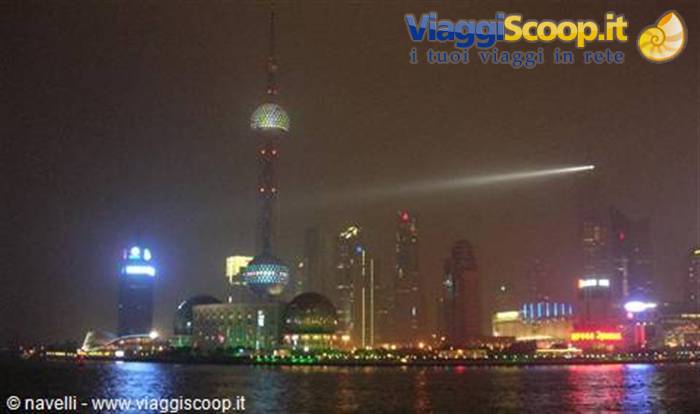
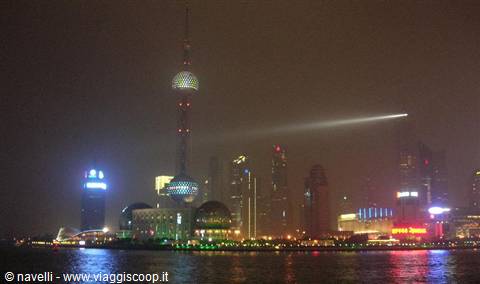
The city by night too amazed us for the abundance and refinement of the illuminated signs, for the lighting of the majestic financial buildings of the Bund, for the evocative liveliness of Pudong and, above all, for the very animated and lively life along and on the Huangpu river. The Shanghai Museum too was significant for having a faint idea of Chinese art and culture. Having left the city we skirt for many kilometres the Grand Canal furrowed by long lines of big barges and after a stop at Qifu, birthplace of Confucius, we arrive in Beijing. Under a scorching sun and an indescribable muggy heat we set about visiting the capital starting from the Temple of Heaven but, above all, from the vast Tiananmen square where the monument to the Heroes of the People stands tall, the Mausoleum of Mao Zedong and the gate of Heavenly Peace which gives access to the Forbidden City.
In the square about ten red flags flutter reminding us that we are in a communist country! The visit to the vast Forbidden City puts us to a hard test, but we are rewarded by a dinner of lacquered duck and an acrobatic show for tourists. The next day we visit the Summer Palace while the following days we dedicate to the less artistic and famous, but more real Beijing, wandering through the hutong, the little alleys where the daily life of the Beijingers swarms, the parks where they go to rest and have fun when they can and the lively little streets of commerce. Having left Beijing, a visit to the Imperial Tombs could not be missing
2 reader comments
Ciao, innanzitutto complimenti per la splendida avventura che avete vissuto. Mongolia Cina e Tibet sono luoghi che sempre ho desiderato visitare, e se tutto va per il verso giusto presso anch'io mi metterò in strada. A tal proposito vorrei farti qualche domanda su alcuni interrogativi. In primis la disponidilità o meno di carburante diesel in mongolia, e poi sulla burocrazia necessaria per entrare in Cina con un veicolo proprio. Se vuoi contattarmi direttamente, il mio indirizzo email è: davide.bacco@fastwebnet.it Ti ringrazio in anticipo. Davide
Ciao, innanzitutto complimenti per la splendida avventura che avete vissuto. Mongolia Cina e Tibet sono luoghi che sempre ho desiderato visitare, e se tutto va per il verso giusto presso anch'io mi metterò in strada. A tal proposito vorrei farti qualche domanda su alcuni interrogativi. In primis la disponidilità o meno di carburante diesel in mongolia, e poi sulla burocrazia necessaria per entrare in Cina con un veicolo proprio. Se vuoi contattarmi direttamente, il mio indirizzo email è: davide.bacco@fastwebnet.it Ti ringrazio in anticipo. Davide