The story
If, besides China, you want to know more about other countries we have visited, go to:
besides precious advice, splendid images will lead you through new cultures...
KASHGAR: Kashgar is the great hub from which the roads leading west depart, and the place where the two routes of the Silk Road that cross Central Asia meet again. Buildings made of mud bricks, tortuous and labyrinthine alleys lead to the workshops of tireless craftsmen who work wood and copper with extreme care and attention. And also travelling merchants who walk silently with their donkey-drawn carts selling the most varied goods, women wandering among the various markets with their heads wrapped in their brown scarves. Characteristic are the walls blackened by the smoke of the ovens that almost continuously produce delicious bread. Fascinating to see piles of meat hung at every corner ready to be bought by the restaurateurs who in the evening would make exquisite shashlik from it (kebab on skewers).
The heart of the old city really seems to have remained unchanged over time, with all its magic, its authenticity. No less is the atmosphere you breathe at the Sunday market, where donkeys, horses, sheep and goats arrive from everywhere in endless numbers, assessed by the attentive eye of the buyers. Minarets silently dominate the scene, reminding the inhabitants of Kashgar that, besides trade, Islam also influences their daily routine. Then the muezzin's call breaks the bustle of activity, urging the faithful to hurry along the narrow alleys to be present for prayer.
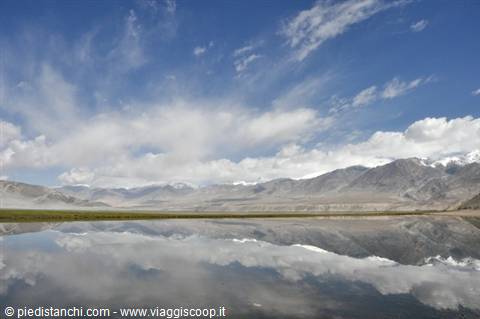
KARAKORUM HIGHWAY: built over about 20 years, this communication route was constructed in order to facilitate the transport of goods and the exchange between the republics of Central Asia and the subcontinent. So great is this road that it is said to be the most colossal work built by man after the pyramids of Egypt. Needless to say, the scenery is very evocative; the eye is drawn to the peaks, among the highest in the world, which change colour, from grey to bright red to sand. After about three hours of travel, you reach the splendid Karakul Lake, at 3,600 m. It is the second highest lake in the world but the highest of the Pamir plateau. There are also Kyrgyz settlements here. Numerous yurts indeed dot the lake shores, and among them yaks and camels grazing peacefully and undisturbed.
TASHKURGAN: The next day we move on to Tashkurgan, capital of the Tashkurgan Tajik Autonomous County. An ancient centre where the population is mostly Tajik and where sheep, wool and derivatives, and especially carpets, were traded. As always, it's worth taking a walk through the market, the beating heart of these places.
URUMQI: to continue with the last part of our trip and head towards the Gansu region, we took a flight to Urumqi. Capital of Xinjiang, it doesn't offer much apart from a visit to the People's Park where you can observe the oddities of the Chinese people. People dancing ballroom dance, others playing their traditional music, improvised little markets where photos and Mao's little red books are sold. From Urumqi the various buses/trains allow you to make various journeys.
TURPAN: about three hours by bus from Urumqi, Turpan is a legendary oasis; its settlements were for a long time important stops on the Silk Road. Also known as Huo Zhou (a place as hot as fire), it is indeed the hottest place in China. Such a high temperature, however, also brings benefits such as creating favourable conditions for growing melons and grapes.
AROUND TURPAN
JIAOHE: one of the oldest and largest and best-preserved desert cities in the world. It is very evocative to walk through its alleys, also because you will be the only ones doing so. Usually, in fact, the masses of local tourists limit themselves to observing the panorama from the highest point of the city and then turning back. A hat is a must. The heat and the sun are really strong. After the visit, a refreshment point at the exit of the site will let you savour delicious, ice-cold slices of watermelon.
TUYOQ: nestled in a valley framed by flaming mountains stands this tiny and peaceful village of winegrowers that offers the opportunity to discover traditional Uyghur life and architecture. Along the gorge there are a series of Buddhist caves.
KAREZ: characteristic of Central Asia, it is an irrigation system that involves a main well being dug on an elevated point to collect water from snowmelt. The karez system then involves digging a long underground tunnel that carries the water to the cultivated fields in the villages. Along the tunnel, vertical wells are then built whose purpose is to allow access to the tunnel itself.
GANSU
DUNHUANG: in an oasis in the middle of the Gobi desert, it is actually a mandatory destination for visiting the famous archaeological site of the Mogao Caves. It presents itself as a cheerful little town that just 6 km away is surrounded by the majestic dunes of the Gobi desert. Among them reigns a curious crescent-shaped little lake, a mandatory stop for local tourism.
MOGAO CAVES: dating back to 366 AD, these caves are decorated with figures carved into the rock, with frescoes and with statues whose dominant theme is religious. The paintings extend over the entire surface of the caves and preserve the largest collection of Chinese Buddhist art. Unfortunately, the restoration of the site has meant that all the atmosphere the site must originally have had has been completely lost. The visit is compulsory guided.
AROUND DUNHUANG: during the day there is the possibility of renting a taxi and taking a trip to the places around the city. Besides the two places mentioned below, along the way you can make a stop to visit an old wall that enclosed the kingdom of the dynasty that ruled this area.
YADAN: characterised by a peculiar desert landscape, it extends in the middle of the majestic Gobi desert, once the bed of a lake shaped by erosion 12,000 years ago. Its rock formations, which create a truly evocative landscape, are singular. Again in this case, the only drawback is that it is impossible to visit it on your own.
CAVES OF THE THOUSAND BUDDHAS: if you visit Mogao it makes no sense to come all the way here. Again in this case the site presents itself as a great pour of concrete inside which there are frescoed rooms. Again in this case, the visit is compulsory guided.
Personal remark: the areas we visited in Gansu, part of the most traditional China, are not particularly attractive.
The journey's photographs
1 photographs · click to open them full screen
0 reader comments