After our tours of India and Sri Lanka, we conclude this trip to Asia by spending 3 days in Nepal, based in Kathmandu and with transfers limited to the closest and best-known places in the valley. Within just a few km we have the incredible opportunity to discover 6 UNESCO World Heritage sites (out of the 7 in the Kathmandu Valley). In the centre of Kathmandu we visit Durbar Square, which features a collection of magnificent Hindu temples, the old Royal Palace and the house of the Kumari, the living child goddess. Around Kathmandu we visit Patan (its Durbar Square and the Golden Temple are stunning) and Bhaktapur. In the Valley be sure not to miss Swayambhunath, a Buddhist temple known as the monkey temple; Boudhanath, one of the most important Buddhist stupas in the world; Pashupatinath, where the cremation of the deceased takes place according to Hindu rite.
To see the sunrise over the Himalayas we choose the town of Dhulikhel.
Day 111 Aug 2016
First approach to Kathmandu
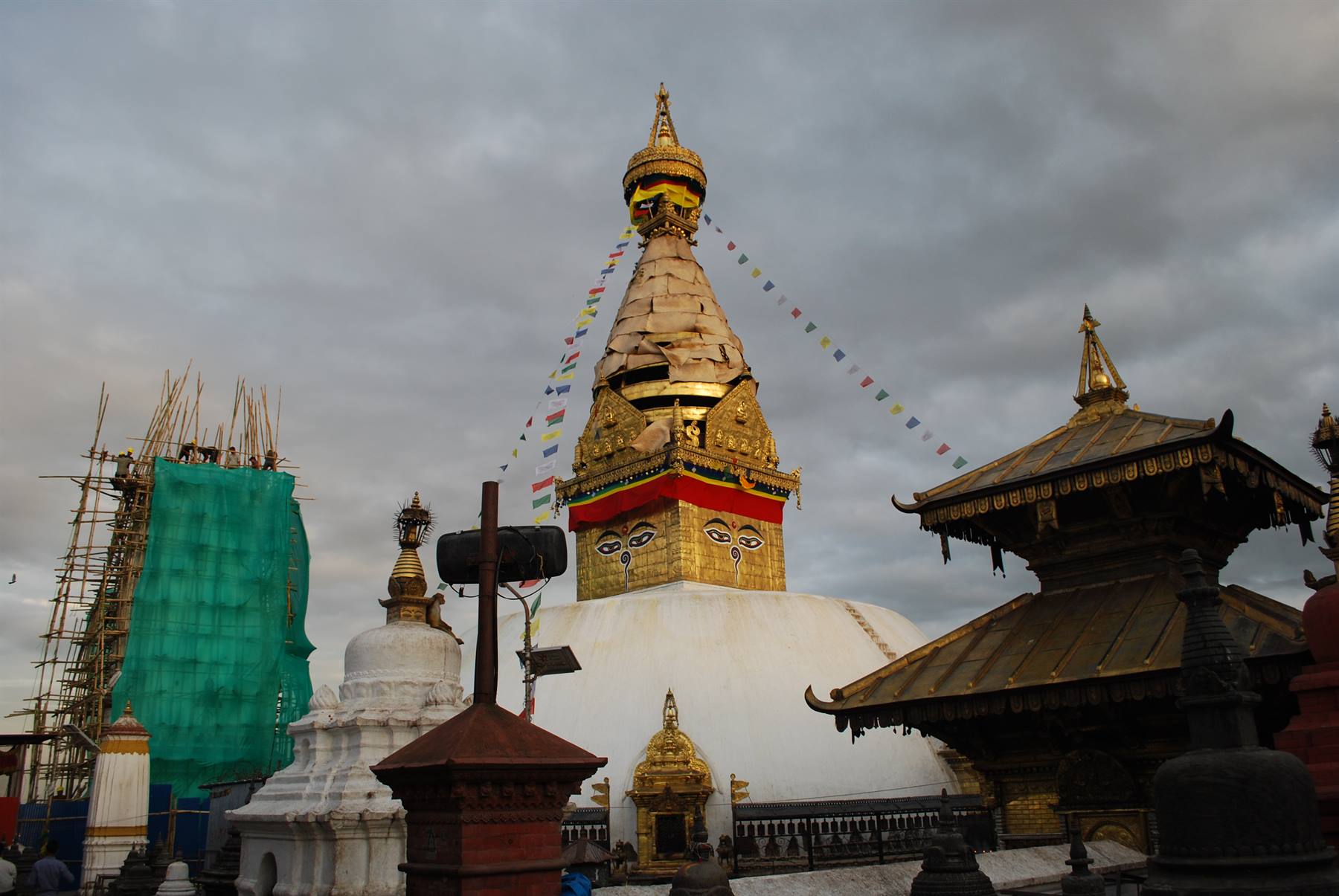
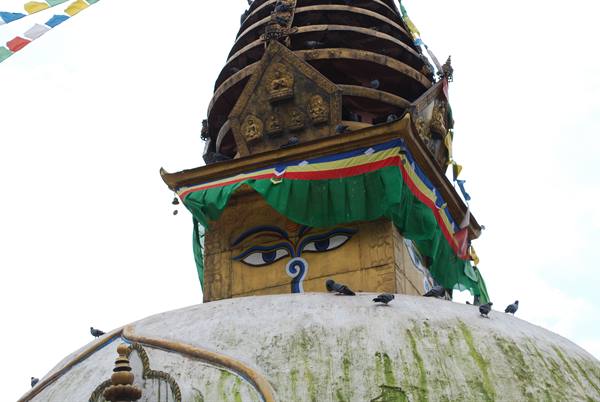
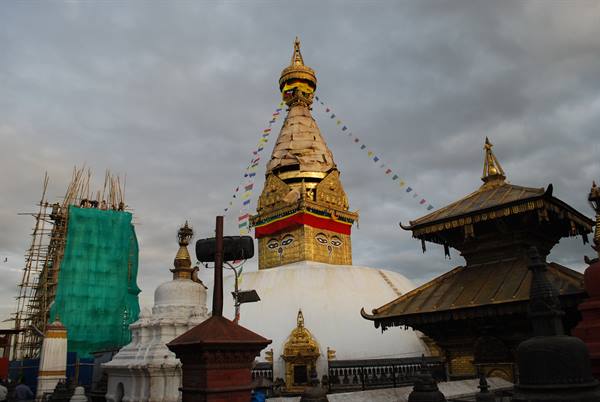
Arrival at the airport at 15:05, then transfer to the Osha hotel, in a central position near Thamel. The first impact with Nepal is positive: less heat and less humidity compared to India and Sri Lanka; but the more time passes, the more our opinion changes. More than seeing poverty we perceive smog, caused by the dust of the post-earthquake rubble, and by the numerous construction sites opened to rebuild houses, buildings, temples. We quickly move by taxi to see the Sunset at Swayambhunath; perched on a hill west of Kathmandu, this Buddhist temple more than 2500 years old offers a spectacular view over the Kathmandu valley; we reach it in 20 minutes by taxi from Tamel (paid entrance). The main stupa is topped by a golden tower with the eyes of Buddha. Swayambhunath is also known as the monkey temple.
At the hotel we make arrangements to rent a taxi for 12 hours the next day, with departure before dawn, and a visit to Dhulikhel, Bhaktapur and Patan; 50 dollars the price. Free dinner in a cheap restaurant near the hotel (7 euros in total for abundant portions for 2 people).
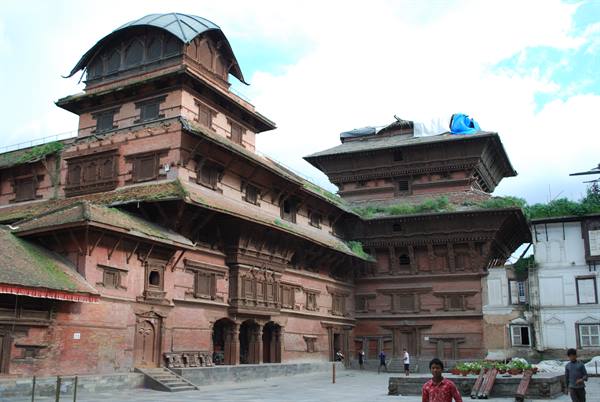
Durbar Square
Day 212 Aug 2016
Kathmandu Valley
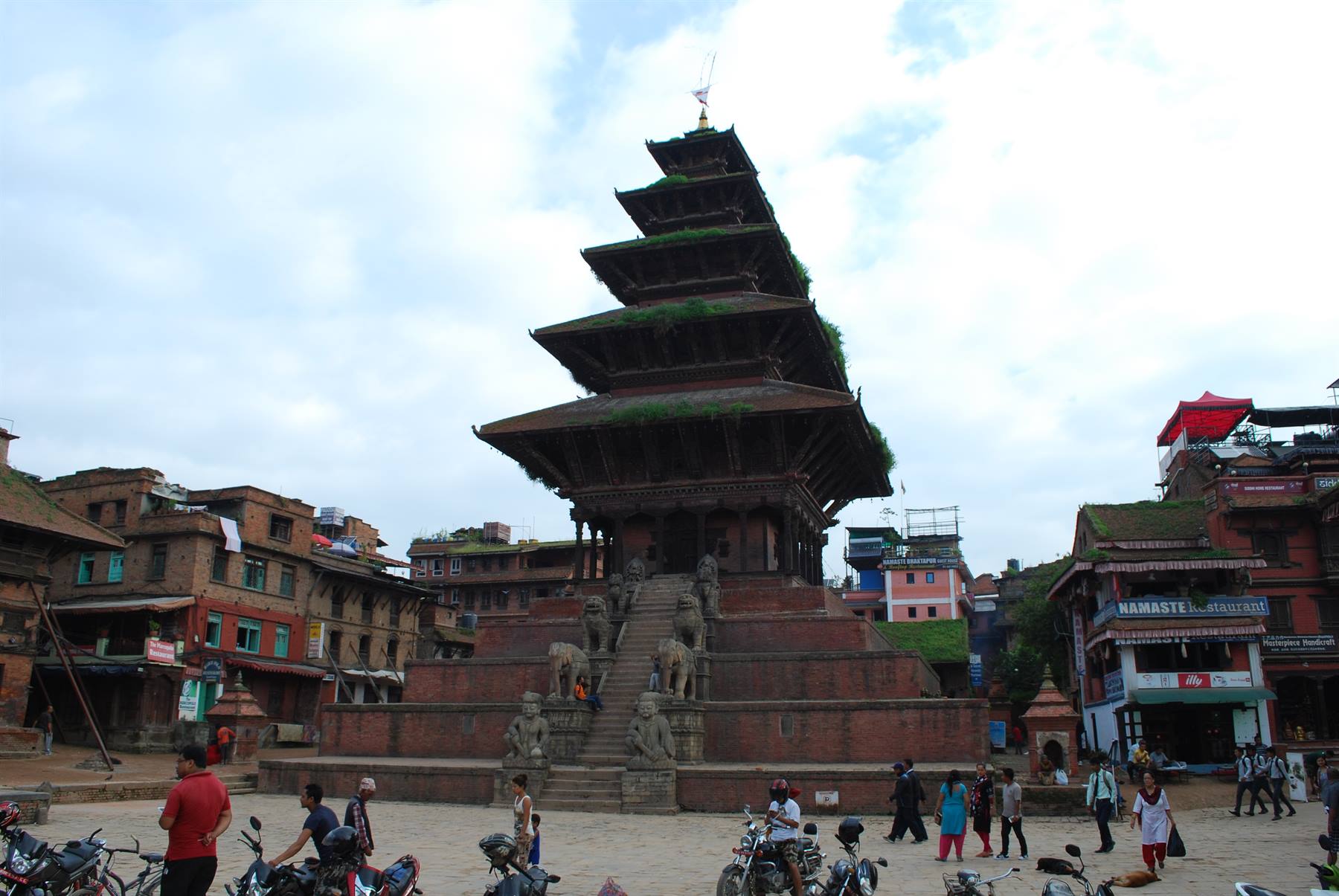
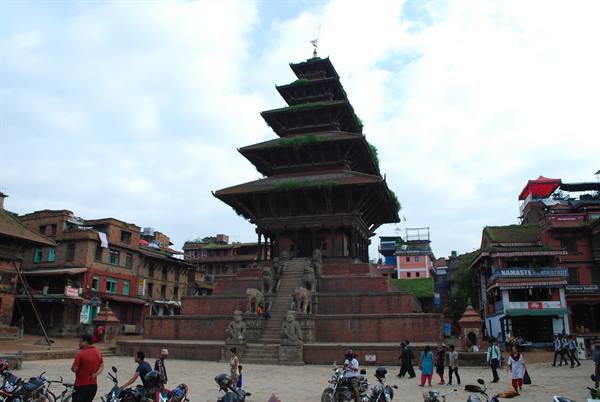
It is better to see the mountains early in the morning because there is a greater chance of seeing the Himalaya. At 5:30 we are in Dhulikhel, 21km east of Kathmandu, which usually offers the best view of the north-eastern Himalaya; the hearty breakfast eaten on a terrace with a view will not be enough to console us for the prevailing cloudiness. At 7 we move towards Bhaktapur. To access the historic center of Bhaktapur you pay a ticket of 15 dollars; Durbar Square is certainly the site least damaged by the 2015 earthquake compared to the same-named squares of Patan and Kathmandu, although the collapses of some temples are visible, as well as the abandonment of several homes and shops no longer usable.
It is very pleasant to wander among the squares and alleys of this Unesco World Heritage city; the Newari style is clearly visible everywhere, and bears witness to the flourishing past of the ancient capital of the kingdom. An ideal place to verify the skill of Nepalese artisans, whom we photograph in their daily activities, and support by buying pashminas, masks, small souvenirs. After a couple of hours of visiting we move to Patan. To access the ancient city of Laliptur, present-day Patan, the entrance ticket is rs750 (about 7 euros); a further ticket of 50 rupees must be paid at the entrance of the Golden Temple. Besides the splendid Durbar Square, the objects of our attention are a temple known for animal sacrifices, and the nearby fountain where the women of the neighborhood wash their clothes. After lunch a visit to Pashupatinath.
Long negotiation with our driver, who does not intend to drive extra km compared to what was agreed, even though we have already returned from the tour in the valley 4 hours early; we agree on 10 dollars to accompany us to the temple of Pashupatinath and the Boudhanath Stupa. The temple of Pashupatinath, located on the banks of the Baghmati river about 8 km from the city, is one of the holiest Hindu sanctuaries. We visit the outer part on the banks of the river and witness the cremation rituals (paid access rs 1,000); only Hindus are admitted inside. The life of many faithful takes place around the river, the same one into which the ashes of the dead are thrown, and where cheerful children wash themselves and play.
The fumes, the smells, the macabre rituals, the poverty of the inhabitants of the area, strike us; the experience of the "Nepalese Varanasi" for a Westerner is truly intense; for the first time on our round-the-world trip we abandon a site promising never to return. We then move towards the Boudhanath Stupa, the largest in the world, topped by a golden spire and decorated with paintings of the eyes of Buddha. To access the Unesco World Heritage site (circular square) the daily ticket costs 250 rupees. Thousands of Buddhist devotees gather in this place every day at sunset to walk around the stupa, 36m high, equipped with butter lamps as a sign of good omen. Currently the dome of the Stupa is damaged and the renovation is proceeding quickly.
Back at the hotel, although after a very long day around the Kathmandu valley, we relax for a moment and decide to follow the advice of some forums and visit the nearby garden of dreams, an oasis of calm in the midst of the bustle of Thamel. Paid entrance rs 200.
Bhaktapur
Day 313 Aug 2016
Durbar Square and around
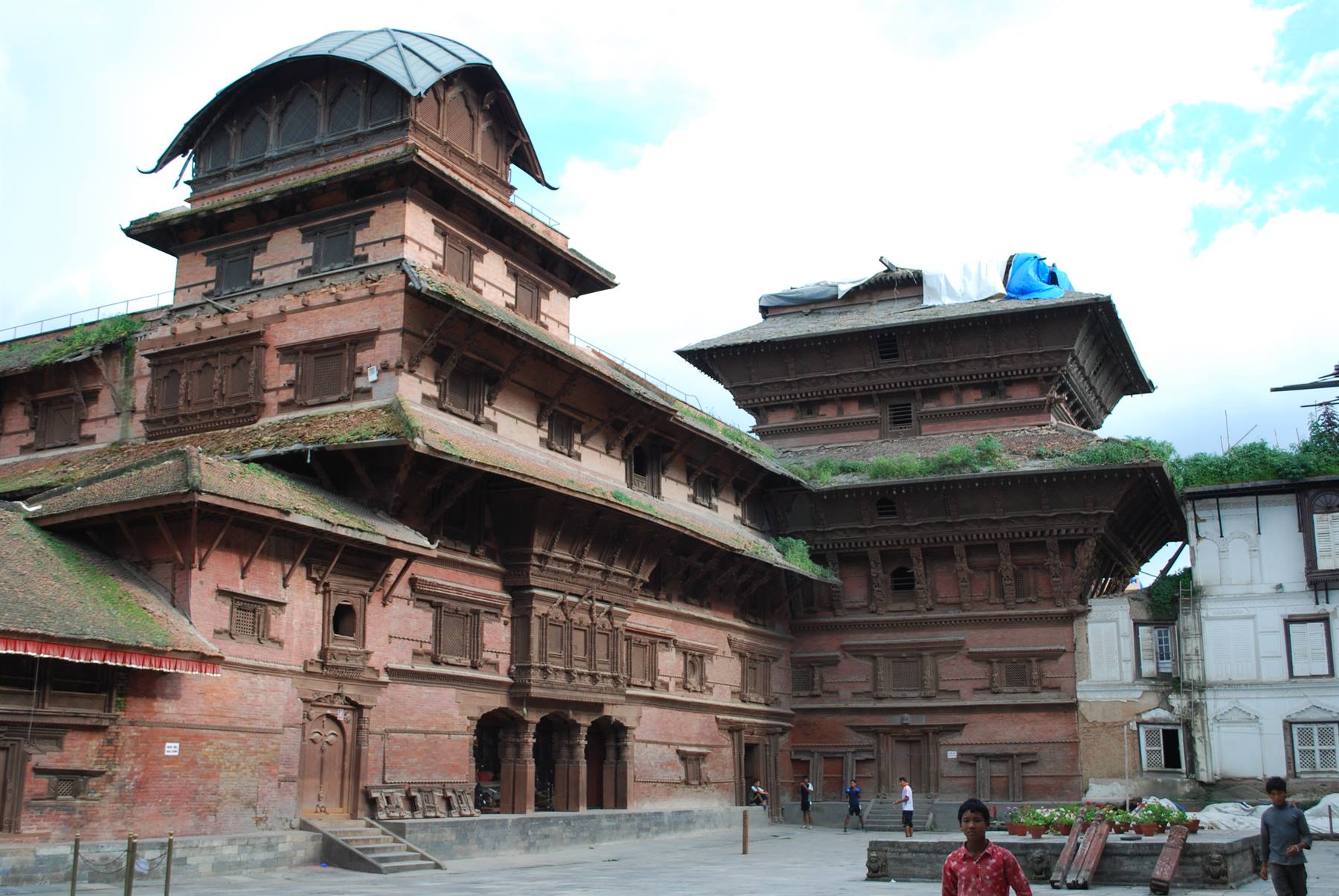
Morning dedicated to the visit of the Kopan monastery, which we reach by taxi (450 rs to cover about 6km in half an hour). Located on a hill overlooking the Valley, the Buddhist monastery was the set of the film 'Little Buddha', an oasis of peace, and meditation courses are held there. Afternoon between Durbar Square and surroundings. We move from the hotel towards Durbar Square relying on our paper guide. One of the oldest sanctuaries scattered through the alleys of Thamel, the Kathesimbhu stupa is located in a secret courtyard near Thahity Tole; surrounded by statues, miniature stupas, children playing soccer. Durbar Square is a square formed by a complex of palaces, courtyards and temples that mark the heart of the old city.
The impact with this square was stronger than in the previous excursions in the Kathmandu Valley; you are assailed by unlikely guides, sellers of flutes or pouches, who will not tire of offering you their wares even if you raise your voice; mothers who ask you for milk for their children, dirty children who ask you for a photo, first, and money, then; the heat, the dust that rises from the rubble of the post-earthquake, the noise of open construction sites and of the hundreds of tourists and faithful walking around, everything contributes to making the visit of the site difficult.
You feel suffocated, for a moment you think that the earthquake has just passed, that people are still screaming for what has just happened; you think that the sellers are after all only asking you for alms because a single euro for them means surviving today, and selling even just a flute, or candles, is more dignified than simply holding out your hand. It takes a good hour before I recover from this shock; I buy a souvenir in the square, as if to prove to everyone that I too leave my contribution, in addition to the one for the exorbitant entrance ticket to the site (1,000 rs).
I finally leaf through my paper guide, and we try to find around us at least a small part of that world I read about, and which for the most part lies under the rubble; the old Kathmandu partly no longer exists, partly is under renovation, little is intact today; even the royal palace, once visitable inside, today shows visible signs of the earthquake. Among the visitable palaces, the best known is the Kumari Ghar dedicated to the goddess Kumari, a child adored by Nepalese Hindus as the incarnation of the goddess Taleju. The child goddess is shown to the crowds of devotees from a balcony inside the temple every day at the same time. The spectacle of her appearance actually saddened us, thinking of the carefreeness of which the child is deprived. In the evening I say goodbye to Kathmandu with one last dinner near the hotel.
Swayambhunath Stupa
Day 414 Aug 2016
Back to Italy
Flight Kathmandu Istanbul at 07:40, arrival at 12:55; departure again at 16:35. Landing in Catania at 18:00.
0 reader comments