Having set off with a friend, we took a special scheduled flight of the Uzbek flag carrier from Milan Malpensa to Urgench. On the plane with us was also the famous Marta Marzotto, invited to Uzbekistan by the daughter of President Karimov. Our plane takes off from Milan shortly after midnight. The plane is packed. We leave Italy, where, despite it being May, it's cold. We will face this journey with an Italian tour operator that has also taken care of the individual visas. Flying with us is also a girl, the representative of the organiser of our trip.
Day 18 May 1993
Urgench and Khiva
Shortly before 9 o'clock the plane lands at Urgench, at the small airport there are no conveyor belts and their task is carried out by the airport staff who, hand to hand, get the suitcases to the hall where we wait. At customs they gave us a paper that we must keep inside our passport until we leave the country. Outside the airport our guide Narghis and a bus are waiting for us. We meet our companions, we're a group of 18 people plus the local guide, the tour operator's representative who was with us on the plane and two drivers. We reach the Hotel Khorezm, it's not great but it's one of the few accommodations for foreigners in the city. After checking the room, we go to the dining room for breakfast but nothing appeals to me and I limit myself to eating a few dry biscuits accompanied by a cup of tea. Shortly after we're on the bus and reach Khiva.
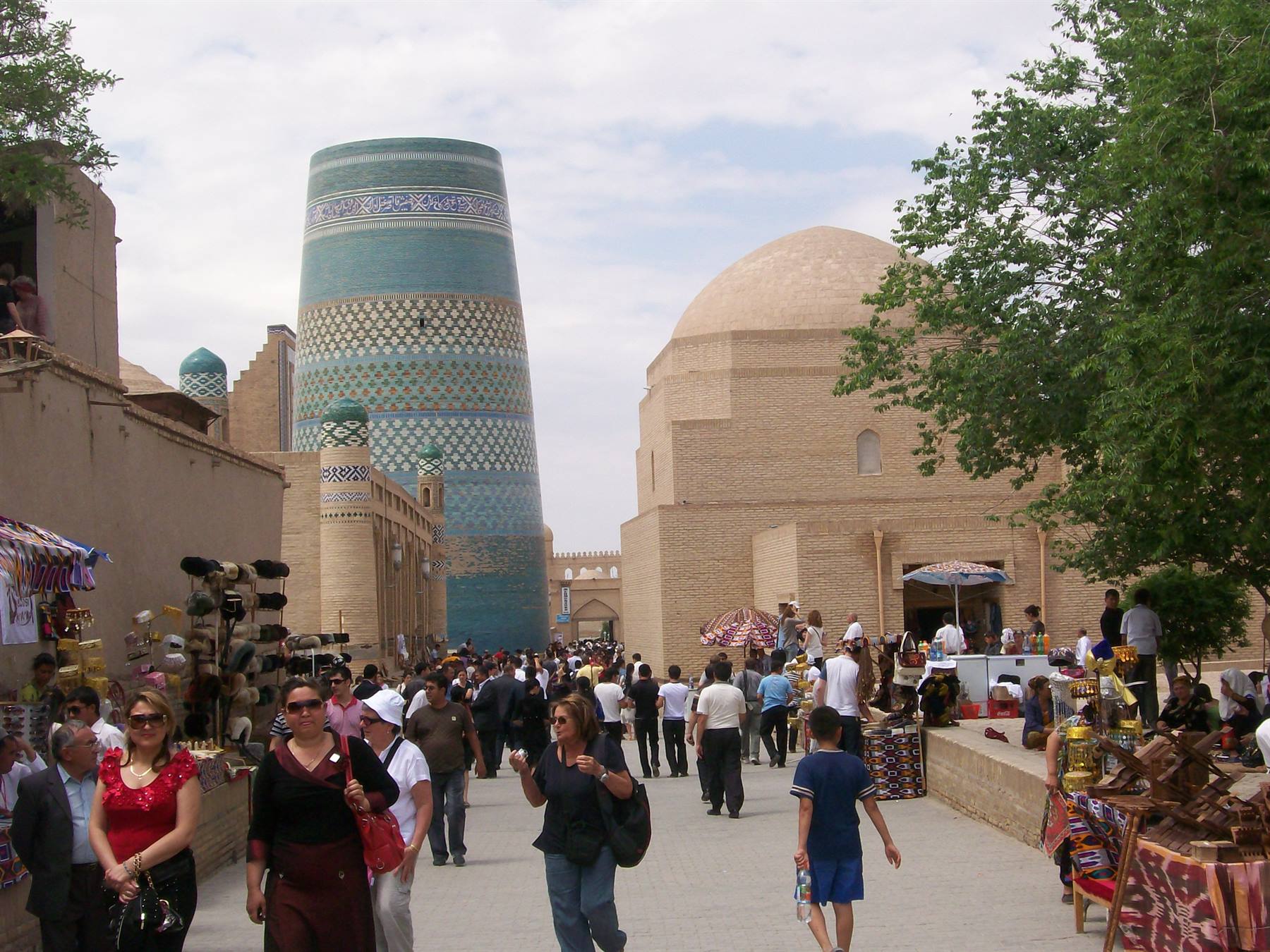
This ancient city perfectly preserved, or rather heavily restored, presents itself to our eyes with its ochre colours on which turquoise portals and minarets stand out. We're lucky because the most important Uzbek folklore festival is taking place and people have come from all over the country bringing their costumes and traditions with them. There's a festive atmosphere, people dance, sing, get married, the atmosphere is sparkling and I can't imagine what the city would be like without all these colours. The Uzbeks are friendly, they gladly have their photos taken, they proudly show off their costumes and the gold teeth that shine in the sun. An elderly lady hands us a piece of unleavened bread on whose surface geometric drawings are made, another proudly shows us a colourful crib for newborns. We interrupt our visit only for lunch in a spartan inn just outside the walls.
Here too the meal is not appealing. Khiva is entirely surrounded by crenellated walls on which turreted gates open. Back in the historic centre we continue discovering characteristic corners of the city. It's almost pointless to list the individual places because the city is interesting as a whole. For the record I'll say that we entered the harem, invaded on the occasion of the Festival by dozens of beautiful girls in traditional dress. Although Uzbekistan is officially Muslim, here religion is lived in a very liberal way. Dozens of years of Sovietization and state atheism have produced a soft Islam found in the absence of burkas but also in the presence of Vodka which is drunk freely here. The symbol of Khiva is a truncated turquoise minaret, the final part was never completed out of envy of the emir of Bukhara.
We enter one of the numerous Koranic schools to watch in the atrium a short balancing act. Two boys directed by their father walk on a rope suspended in the air then come down and take their leave of us playing traditional instruments. The Sultan's palace has a bastion from which you enjoy a beautiful view over the valley. From here you realise how the area where we are, Khorezm, is an oasis surrounded by desert. In particular around Khiva two deserts extend, the Kyzyl Kum and the Karakum. The latter, the black desert, is already beyond the border, in Turkmenistan. We leave Khiva satisfied with a day rich in emotions. We return by bus to the hotel in Urgench where we have dinner. Eating is a problem for me, wherever we go we find a rich assortment of raw vegetables that are not advisable at these latitudes.
Fortunately here you can drink green tea at will and it's indispensable to do so given the heat that has accompanied us all day. After dinner with my friend we take a walk in the main square of Urgench which is really a stone's throw from the hotel. It's an artificial city centre, you can see it was created from nothing, without a history behind it. The local authorities gave the place some dignity by placing a golden monument of Al Gebr, the man who invented algebra, a few neoclassical columns arranged in a semicircle and a clock tower. In Europe we would never call this somewhat kitsch architectural assemblage a square, first of all because in fact it's a large lawn and then because the most important element is missing, the people who frequent it. Moreover Urgench is dark, the lighting very poor.
To find some people you have to cross to the other side of the road where there's a kind of open-air bar where a boy cooks meat skewers on the grill. It seems this is the culinary speciality of Central Asia but we will never be offered it. On the street a man apparently in his fifties approaches, he tries to tell us something but his tongue trips and he smells of alcohol, I imagine he's not very interested in Muhammad's precepts. To avoid such encounters we return to the hotel for the night. Our room with two single beds is cramped, some lamps don't work and the television broadcasts few satellite channels. On the other hand on one channel they show the Khiva Festival where I see interviewed the seller from whom I bought a small picture a few hours earlier.
Khiva
Day 29 May 1993
Kyzyl Kum and Bukhara
Wake-up at 6 in the morning and immediate departure by bus for Bukhara. In fact, I skip breakfast at the hotel because nothing seems recommendable for my extremely sensitive stomach. The Khorezm region is the only part of the country south of the course of the Amu Darya, a river that has represented for centuries the lifeblood of this part of Asia. Until a few decades ago the Amu Darya fed the Aral, which was the largest lake in the world after the Caspian (which however is wrongly considered a sea) but now its waters, overexploited for irrigating the cotton fields, are lost in the desert and this has caused the drying up of much of the Aral and the resulting environmental disaster.
After crossing the bridge over the river we follow its course for a stretch that marks the border with Turkmenistan, another former Soviet Republic now ruled by a ruthless dictatorship likened according to international humanitarian organizations to that of North Korea. We stop for a short break on the bank of the river beyond which, in Turkmen territory, stretches the vast Karakum desert. For a long stretch we cross the Kizyl Kum, the steppe desert that occupies much of central and western Uzbekistan, then spilling over into Kazakhstan. It seems that it rarely rains here but right in the desert we are caught in a downpour. Desert enthusiasts will certainly not find great interest in the KyzylKum, a vast territory of desolation crossed by a wind-swept road.
After about seven hours of travel we arrive in Bukhara where we take a look at our accommodations at the Grand Bukhara Hotel located in a tall Soviet-style building. The hotel is definitely better than the one in Urgench; the room assigned to me and my friend is spacious and comfortable. Even the buffet lunch, served in a large and elegant hall, is better than the one eaten in Khiva the day before. They had given us a double bed but we asked for and got the beds separated. The bathroom has a bathtub but there's no plug so we'll have to make do with the shower. Three Italians, one of them from our group, fare worse: the elevator gets stuck between floors. They tell me it would take little to get it going again but at the reception they are not authorized to touch it and so they call the technician and the unfortunate tourists are forced to a long wait.
Once the problem is solved we get on the bus and go to visit Char Minar, what remains of the guardhouse of an ancient Quranic school. The small building, reachable on foot along a narrow maze of dirt roads, is one of the symbols of the city. Inside there is a souvenir shop and for a fee you can also climb the four minarets that make this not-large construction elegant and photogenic. Heading back toward the bus we notice that despite the uneven roads and the extreme poverty of the people, here everything is clean and it's almost impossible to find a piece of paper on the ground. The area is not immune, however, to bad smells; the sewer system is absent and the heat favors the spread of the stench. By bus we arrive in the city center; Lyabi Hauz is a large square surrounding a big pool.
Once, Bukhara had numerous pools that were periodically filled with water for the water needs of the inhabitants, but given the poor turnover this caused numerous serious diseases and so it was decided to fill them in and use an aqueduct. Recently there has been a rediscovery of these pools, which have been reopened no longer for drawing water but as an architectural element. The Square looks very tranquil; around the pool open cafes and large tree-lined areas that protect from the sun the locals busy playing a kind of checkers or sipping a cup of tea. Facing onto Lyabi Hauz are ancient buildings including two madrasas with the characteristic tall portal that distinguishes the Islamic buildings of this part of the world.
In particular, the Nadir Divanbegi Madrasa has inside a large courtyard surrounded by centuries-old plants and by what were once the students' lodgings and are now shops for tourists. The local guide leaves us free to visit the surroundings of the Square; my friend and I walk through the historic center to the small covered bazaar of Taqui Sarrafon. Just beyond the arch of the Bazaar, inside an ancient Caravanserai, we visit a characteristic wine shop where my travel companion, a wine enthusiast, samples a series of Uzbek wines, which, truth be told, in his opinion, are absolutely mediocre. The two elderly owners, however, are likable and, as we have found in many people of this country, very hospitable. We return to Lyabi Hauz where we witness an embarrassing scene.
A man is lying on the ground, apparently drunk; some boys grab him by the hands and feet to throw him into a ditch that passes nearby; they see that we are watching so they desist and leave the person lying at the edges of the Square. Many observe the scene but no one intervenes. In Italy we would have intervened in defense of the man and to make sure of his health but we are abroad and we prefer not to meddle. Shortly after we meet the rest of the group and the guide; we are intrigued by some large Dutch cars parked there that are traveling the long Silk Road. Now as then, Bukhara represents an important crossroads of the roads that connected the Mediterranean and Europe to China. All together we walk the narrow alleys that connect the historic center to the hotel district and go to dinner at the Hotel.
As always it's hard to find foods that aren't dangerous for our stomachs since fresh vegetables and fruit continue to dominate. Personally I save myself with boiled rice, their characteristic unleavened bread and a couple of cups of green tea accompanied by some dry biscuits. Near the Hall there is a room with internet access but there's no ADSL and browsing is slow. We then go to our room for the night.
Khiva
Day 310 May 1993
Bukhara
Upon waking we have breakfast at the hotel, avoiding the inviting but dangerous fresh fruit and yogurt but trusting the tea in which we dip dry biscuits. By bus we move to Samani Park where, in addition to artisans' stalls and rides, there are two Mausoleums. The first is one of the oldest constructions in the city (900), has finely decorated walls but sparse interiors and was built by Ismail Samani, the founder of the Samanid Dynasty. The second, not far away, is linked to the memory of the biblical Job. Tradition holds that Job, striking the ground in this place with a staff, caused a spring of water to gush forth. True or not, the water flows abundantly inside the Mausoleum and the faithful rush to bottle it. We visit this place trying not to disturb those who are praying. The city is rich in greenery; after all, it is located in a lush oasis surrounded by the Kyzyl Kum desert.
The vast majority of the inhabitants are Tajiks and live in harmony with their Uzbek compatriots. Very different, however, are the relations between Uzbekistan and Tajikistan; since the dissolution of the Soviet Union the Central Asian Republics have become independent but have lost Moscow's economic support; the resulting economic upheaval has caused a rapid worsening of their relations and the raising of borders that were once only formal and are now impassable. Just outside the Park stretches the area of the Ark, that is the citadel of the Emirs' power, a true city within the city, entirely surrounded by mighty walls. In front of the Ark is a large square overlooked by a Mosque with a splendid wooden portal dotted with numerous columns. At the foot of the colonnade one of Bukhara's many pools.
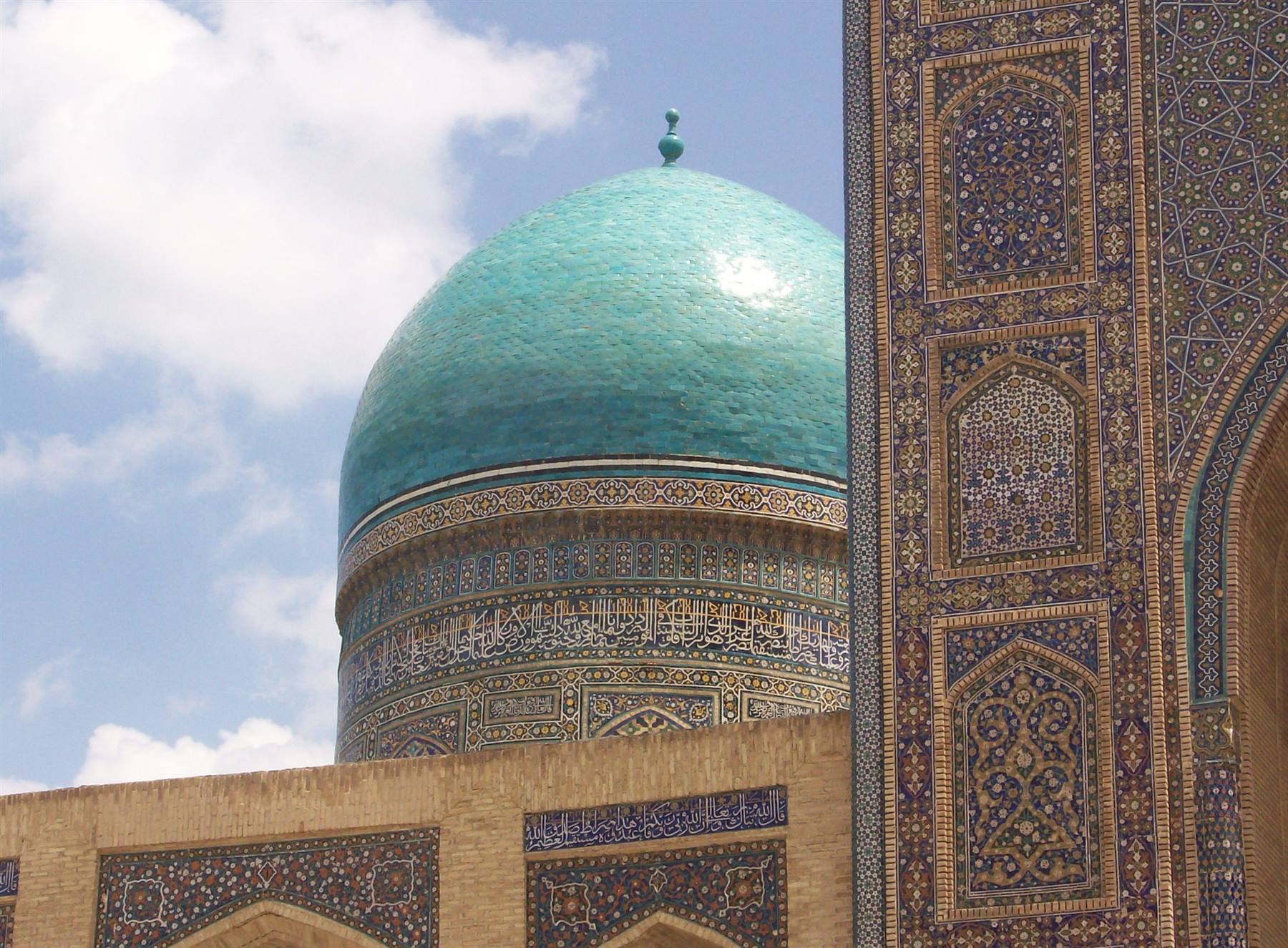
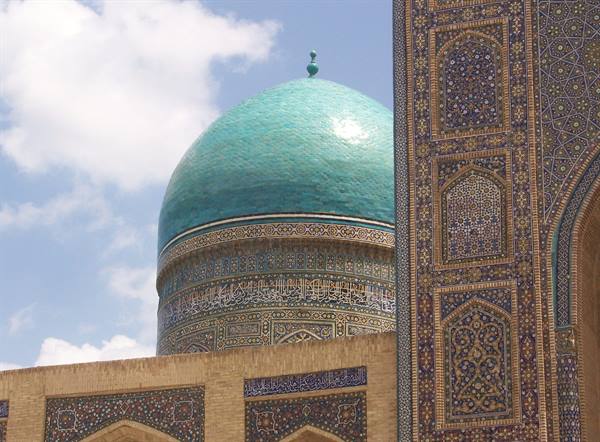
Inside the Ark you visit some courtyards and rooms including the Juma Mosque and the Emir's audience hall. There is also a small Museum on the various stages of the city's history. After leaving the Ark we reach on foot a small market and the architectural complex that includes the Kalon Mosque and the Mir I Arab Madrasa. The latter was one of the rare religious buildings allowed to remain open even in the Soviet era; very different was the fate of many other Mosques and Madrasas of Central Asia that were turned into factories, warehouses and granaries. For tourists it is not possible to enter the Madrasa and one just looks at the courtyard through a slit. You can instead easily visit the beautiful courtyard of the Kalon Mosque. Overall the Kalon area is a set of bulbous domes and majestic portals in which blue predominates in its many shades.
The most important piece of the complex is certainly the tall Minaret, once the tallest building in all of Central Asia. From here we return by bus to the hotel district and have lunch in the large Hotel next to ours, definitely more beautiful. In the luxurious dining room, however, they continue to set up the buffet with many risky things, most of which I avoid putting in my stomach. I defend myself with the usual rice, which here they serve in abundance. After lunch we take the few steps needed to go to our Hotel and go up to the room for a short rest. In the afternoon we reach the Kalon area by bus; the sun has been obscured by clouds allowing us to photograph Mosque and Madrasa; the Minaret is instead too tall to frame it completely.
We stop in a large shop where they produce the famous Bukhara carpets with large looms and follow part of the work, a real treat given that by now most of these artisanal works are made in nearby Turkmenistan where labor is low-cost. It's a small world!! From here in a few steps we are in one of the covered Bazaars of the City, that of Taqi Zargaron, where a spice seller explains to us the high healing power of some medicinal herbs and lets us taste a particular type of tea. Shortly after the Bazaar are found, facing each other, the Ulughbek Madrasa and that of Abdul Aziz Khan. Deconsecrated for years, the Madrasas house souvenir and craft shops. In the one built by Ulughbek we visit a small room that has remained just as it was when the students of Islamic theology lived there; in the other I buy a small suzanè, a typical Uzbek embroidery used as a tapestry.
While a short distance from here we visit a shop that produces embroideries made with gold thread, we are caught by a violent but quick downpour accompanied by gusts of wind. Once we reach the historic center we enter the Maghoki-Attar Mosque, probably older than the one in Samani Park since it seems it was built on the foundations of a Zoroastrian Temple (remember Zarathustra!!). The interior displays an exhibition of carpets. From here we quickly reach the Hotel and I am quite happy about it because the tea offered to me at the Bazaar by the spice seller had a strange effect and despite my care with food and the daily dose of enterogermina my belly is growling and demanding a toilet. Once the unexpected problem is solved at the Hotel and I've changed for the evening, I reach Lyabi Hauz Square by bus with the rest of the group.
Tonight we will dine in the atrium of the Nadir Divambegi Madrasa. Here too the dinner is not inviting; Uzbek cuisine is monotonous and they rarely bring you the local specialties. Tonight we are slightly lucky because in the meager menu there is the famous pilov, that is vegetable risotto. We dine while in the center of the courtyard we are offered a show of traditional costumes and dances accompanied by the notes of a small musical group. The show is not exceptional but pleasant. After dinner we return by bus to the Hotel for the night.
Bukhara
Day 411 May 1993
Bukhara, Shakhrisabz and Samarkand
After the usual meagre breakfast at the hotel we get on the bus heading for the legendary Samarkand. The road initially crosses the desert but then, as we get closer to our destination, the landscape becomes gentler until it turns green and cultivated. We make a stop at what could be a "motorway service area" even though in reality it is very different from our service stations. Besides stretching our legs we taste the flaky bread, a speciality of the area produced in a smoky semi-basement where I dare to go in. Some women knead and bake dozens of loaves that are halfway between a piadina and puff pastry. I taste the freshly baked bread but the mutton they are cooking outdoors in a big iron pot I really can't bring myself to take. They say it's good but my stomach rejects it.
Once back on the road we stop at Shakhrisabz, a city with an almost unpronounceable name that was the birthplace of Tamerlane. The great commander who tried to retrace the deeds of the Mongol Genghis Khan, and partly succeeded, ruled a vast empire right from this city where he had an enormous palace built of which unfortunately only a few remains of the entrance portal are still standing. But a fleeting glance at the crumbling structure is enough to realise how large, mighty and beautiful this building must have been. Watching over forever what remains of this complex is the tall bronze statue of Tamerlane. In the city we also visit the Friday Mosque with the Mausoleum of Sheikh Shamseddin Kulyal and the nearby Khazrati Imam complex where we enter the bare Crypt of Tamerlane.
Near Shakhrisabz but already in the countryside, we have lunch in a large Tajik trattoria where, despite the usual precautions, we don't eat badly at all. We resume our bus transfer through an area of green hills where we frequently come across shepherds with their flocks. The ups and downs of the road take us to Samarkand where we go to take possession of our rooms at the Afrosiab hotel. The hotel is the classic Soviet-style accommodation facility even though slightly modernised, the room is still decent. It is still daylight so my friend and I take the opportunity to go for a walk and have a first furtive look at the nearby Registan Square. We also go into a modern supermarket where my friend buys a bottle of local wine, bitterly regretting it since once back at the hotel he will prefer to get rid of it.
We return to the Afrosiab for dinner then go out again for an evening walk in search of an internet point that we fail to find. On the other hand, by moving even just a little away from the historic centre, we have the opportunity to see the remarkable building development that Samarkand is experiencing, there are hundreds of new buildings under construction and building sites everywhere. The roads and pavements on the other hand are broken up and public lighting is scarce. Our hotel is in a strategic position between the Registan and the Mausoleum of Tamerlane so before going back we decide to go and see the latter. A wise decision because we have the Mausoleum all to ourselves and can admire it both outside thanks to the skilful blue lighting, and inside.
The mausoleum is entirely decorated with mosaics and marble and we are left ecstatic admiring the bulbous dome that towers over the simple sarcophagi of Tamerlane and his family members. Leaving the Mausoleum we meet Marta Marzotto and her companions. They are escorted by the Police as they are guests of the State. We exchange a few words with Mrs Marta then go back to the Hotel satisfied for the overnight stay.
Bukhara
Day 512 May 1993
SAMARKAND
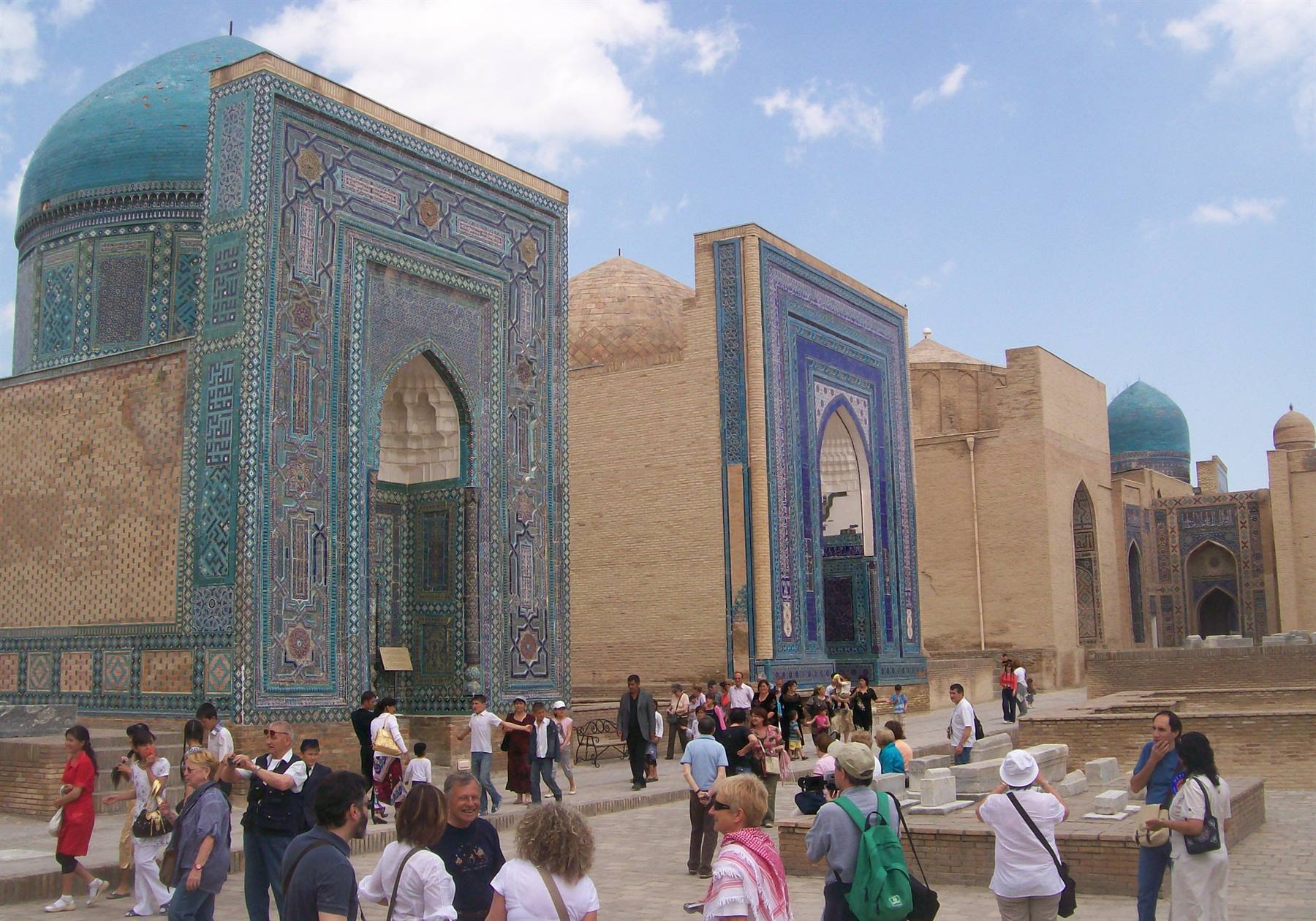
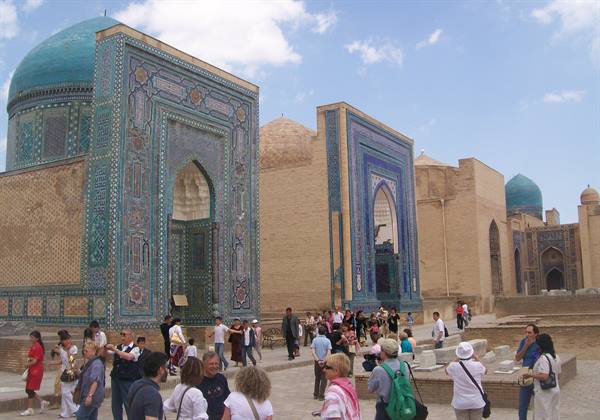
After breakfast at the Hotel we go up a hill to visit the ruins of the ancient city of Afrasiab and its Museum. The museum display, thanks also to our guide's explanation, is quite interesting, while the ruins are of little significance. From here we move on to the Tomb of Daniel, a long, low building with domes that houses a sarcophagus fully 18 metres long, around which one walks. According to tradition, the body of the Prophet Daniel is placed here, transferred from Iran. Legend has it that the body grows by one centimetre a year, and since the Prophet lived in the 5th century BC, it's only natural that the sarcophagus is so long. We then move on to the Necropolis of Zinda, a beautiful architectural complex and in my opinion more spectacular than the famous Registan Square.
It is a long series of funerary chapels in the classic Central Asian style, completely covered in coloured majolica tiles. Many have criticised the heavy restoration imposed by the Dictator Karimov, which has made it lose part of its originality, but the overall view of the whole area is one of those you don't easily forget. We stroll along the uphill avenue lined with the chapels built by Tamerlane and Ulughbek for their relatives, but more than the individual building and the history of those it houses, we are in raptures over the complex as a whole. Coming down from the hill, we go by Bus to the Hotel President, which will host us for the next two nights. This hotel is definitely nicer; the huge lobby recalls the atrium of a cruise ship and is surrounded by various floors of terraces clad in marble.
With the glass-walled lift we reach the floor housing the rooms, then go back down to join the others and transfer to the Hotel Malika, for lunch in a room with fine ethnic touches. In the afternoon we go to Tamerlane's Mausoleum, which I had already seen the previous evening, among other things much more beautiful in the darkness than kissed by the sun. Compared to the previous evening's visit, I have the comfort of the guide, who points out to me the tombs of Tamerlane and his nephew Ulughbek. Not far from here we make our way to Registan Square, which I had also glimpsed briefly yesterday. It is undoubtedly the main and most famous attraction of the whole of Central Asia. It is a broad square overlooked on three sides by the Madrasas of Ulughbek, Sher Dor and Tilla-Kari, with their characteristic Central Asian architecture covered in millions of coloured majolica tiles.
The Madrasas, which originally were Koranic schools and which during Soviet rule were used as granaries, today house various craft shops aimed at the numerous tourists. In the Sher Dor Madrasa a merchant invites us to watch a musical performance with typical local instruments; another, telling us the history of Central Asian costumes, has us put on part of this clothing. We almost lose sight of the solemnity of the place where we are, now completely given over to mass tourism. This evening we dine at the Hotel President, the same one where we are staying, an early meal to allow us to go to the Theatre. The show consists of a performance of traditional dances in costume performed by a group of young students, with the explanation in Italian provided by their Professor. The performance is not exceptional and isn't worth the ticket price.
There's nothing left but to return to the Hotel for the night.
Samarkand
Day 613 May 1993
SAMARKAND AND SURROUNDINGS
After breakfast at the Hotel we transfer with the usual Bus, with which we have done the entire Tour, to the locality of Hoja Ismail to visit the Mausoleum of Al Bukhari. This is one of the most sacred places in Islam, since the literary work of the scholar Ismail Al Bukhari is considered by Sunnis second in importance only to the Koran. For this reason his Mausoleum has become a busy place of pilgrimage. The complex strikes you with its pure white, enhanced by a splendid sunny day; it comprises, among other things, the Mosque, two courtyards and the marble tomb of Al Bukhari. More than the Mausoleum, however, I am drawn to the many faithful with their beards and turbans. On the road back to Samarkand we stop at a paper mill where the processing is still carried out using traditional techniques. The entire production process is carried out without the use of electricity.
The pestles rise and fall thanks to the force of the water from the nearby stream, the cellulose pulp is put into a rectangular mould, sieved and placed in a press to turn it into a sheet of paper. The setting in which the paper mill is located is also very beautiful: we are in a grove with a stream flowing through it. Back in Samarkand we visit the great Bibi Khanym Mosque, which, commissioned by Tamerlane, was among the most imposing mosques in the World before it crumbled over time! The coup de grâce was dealt by an earthquake at the end of the 1800s. Despite this, wandering among the imposing remains of what was a jewel of the Islamic World is interesting, also because the dimensions of what has survived to our day give a sense of how majestic the complex must have been. Moreover, recent restorations have restored the enormous main entrance and a few domes.
After lunch in a characterful restaurant whose dining room features a choreographic fountain, we go to the Siob Bazaar, located behind the Bibi Khanym Mosque, but to tell the truth it's disappointing. From here, with a long walk, we reach Registan Square, near which the Bus awaits to take us to the Hotel President for dinner. After a short stroll around the Hotel, where we find an internet point to browse, we retire for the night.
Samarkand
Day 714 May 1993
TASHKENT
Breakfast at the Hotel, then a long transfer to Tashkent. The road we travel runs for a long stretch alongside the border with Kazakhstan and is often close to high mountains. We arrive in the Capital for lunch in a large but anonymous Restaurant. We take a brief panoramic tour by bus, passing in front of the equestrian statue of Tamerlane and Independence Square, where the sumptuous white Senate building, recently built, is located. We drive along the city's broad avenues in perfect Soviet style. We stop in a tree-lined Square with a choreographic fountain; I leave the group and take the opportunity to walk to Independence Square. Reunited with the others, we set off again to transfer to the airport, from where we take the direct flight to Milan.
Salve,
siamo INCOMING TOUR OPERATOR dell'Uzbekistan.
Questo e’ un preventivo classico (per i viaggiatori).
Posso organizzarvi un ottimo tour in Uzbekistan.
Prenotate il volo internazionale e prendete il visto uzbeko.
Tutti gli altri servizi faccio io...
Se avete le domande del viaggio, potete chiedermi. Sono sempre pronto di rispondervi
Tour classico - 8 giorni.
Tashkent-Urgench-Khiva-Bukhara-Shakhrisabz-Samarkanda-Tashkent
Prezzi del tour e’ per individuali di:
796 EURO a testa per 2 persone;
693 EURO a testa per 4 persone;
634 EURO a testa per 6 persone.
Prezzi sono validi dal 01.03 al 30.10.2013
ALBERGHI – Prenotiamo la stanze STANDART negli alberghi 4**** a Tashknet (Tashkent Palace o un altro), a Khiva 3*** (Shakherezada Khiva o un altro), a Bukhara 3*** (Amelia Boutique o un altro), a Samarcanda 3*** (Malika Prime o un altro).
La quota comprende:
• Trasferimento colla macchina (aeroporto/hotel/aeroporto);
• Macchina con aria condizionata;
• Guida locale parlante italiano per tutto il tour;
• Tutti gli ingressi ai musei ed escursione come da preventivo;
• Stanze doppie in albergho;
• Pensione mezza (colazione e cena);
• Ogni giorno 1,5 litro acqua liscia a testa;
• Il volo locale Tashkent/Urgench;
• Spettacolo e concerto folkloristico a Bukhara;
• Trasporto dei bagagli aeroporto/hotel/aeroporto.
Riesco a darvi i migliori prezzi con i migliori servizi.
Abbiamo tantissimi programmi, potete darli una occhiata sul nostro sito.
Grazie
Salutoni Faruh
Faruh HODIEV
******************
TOUR OPERATOR
& Sales Manager parlante italiano
Indirizio: Via K.Ashurov 1/12, 140105
Samarcanda, Uzbekistan
Tel/Fax: +998 66 235 1894
E-mail: st-italia@sarbon-tour.com
www.sarbon-tour.com
Skype: faruh.hodiev
Licenza n° 378-03 Tashkent 17/02/2004 - Uzbek Turismo
1 reader comments
Salve, siamo INCOMING TOUR OPERATOR dell'Uzbekistan. Questo e’ un preventivo classico (per i viaggiatori). Posso organizzarvi un ottimo tour in Uzbekistan. Prenotate il volo internazionale e prendete il visto uzbeko. Tutti gli altri servizi faccio io... Se avete le domande del viaggio, potete chiedermi. Sono sempre pronto di rispondervi Tour classico - 8 giorni. Tashkent-Urgench-Khiva-Bukhara-Shakhrisabz-Samarkanda-Tashkent Prezzi del tour e’ per individuali di: 796 EURO a testa per 2 persone; 693 EURO a testa per 4 persone; 634 EURO a testa per 6 persone. Prezzi sono validi dal 01.03 al 30.10.2013 ALBERGHI – Prenotiamo la stanze STANDART negli alberghi 4**** a Tashknet (Tashkent Palace o un altro), a Khiva 3*** (Shakherezada Khiva o un altro), a Bukhara 3*** (Amelia Boutique o un altro), a Samarcanda 3*** (Malika Prime o un altro). La quota comprende: • Trasferimento colla macchina (aeroporto/hotel/aeroporto); • Macchina con aria condizionata; • Guida locale parlante italiano per tutto il tour; • Tutti gli ingressi ai musei ed escursione come da preventivo; • Stanze doppie in albergho; • Pensione mezza (colazione e cena); • Ogni giorno 1,5 litro acqua liscia a testa; • Il volo locale Tashkent/Urgench; • Spettacolo e concerto folkloristico a Bukhara; • Trasporto dei bagagli aeroporto/hotel/aeroporto. Riesco a darvi i migliori prezzi con i migliori servizi. Abbiamo tantissimi programmi, potete darli una occhiata sul nostro sito. Grazie Salutoni Faruh Faruh HODIEV ****************** TOUR OPERATOR & Sales Manager parlante italiano Indirizio: Via K.Ashurov 1/12, 140105 Samarcanda, Uzbekistan Tel/Fax: +998 66 235 1894 E-mail: st-italia@sarbon-tour.com www.sarbon-tour.com Skype: faruh.hodiev Licenza n° 378-03 Tashkent 17/02/2004 - Uzbek Turismo