The story
if you want to know more or see all the photos visit:
20.02.2016 Tbilisi (Georgia)
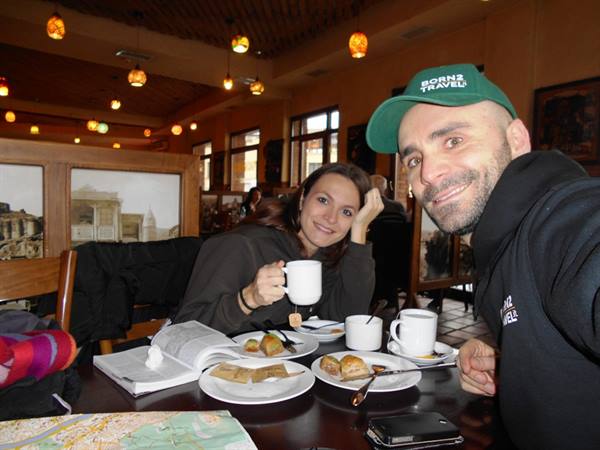
[Stefy]: "After a warm cup of tea and two baklava, we take a stroll through the historic centre, not far from the Church of Jvaris Mama and that of Norasheni. The old town is very pretty, a maze of little streets characterises this very ancient area that locals call Maidan or Kala. In the little square of Gorgasalis, we meet two couchsurfing friends, Peppu from India and her Sri Lankan boyfriend. We spend a few hours with them, chatting about India, about travel, about their medical studies in Tbilisi and the difficulties of living abroad.
We go to the Church of Metekhi, where, by pure chance, we witness an Orthodox ceremony; the priest makes the sign of the cross on the foreheads of the faithful while they kiss the cuff of his tunic." Tbilisi is a surprising city: if some corners, typically Soviet, made me recall the old Latvia, many others belong to a city that is slowly trying to open up to Europe and the West. Let us remember that it is now 25 years since it gained independence from "Great Mother Russia" and that only recently it managed to free itself from the anarchy into which it had fallen.
21.02.2016 Tbilisi (Georgia)
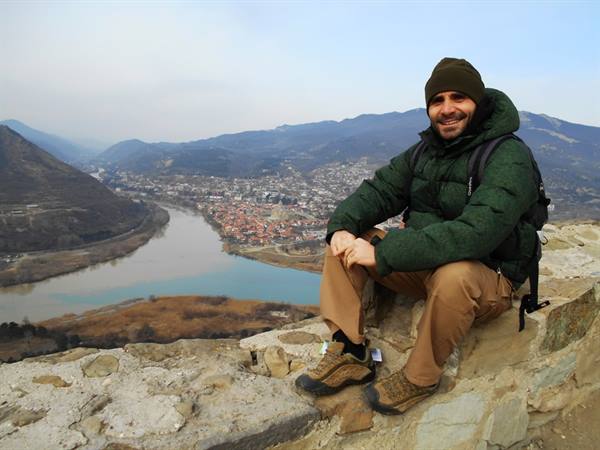
Mtskheta is home to some of the country's oldest churches and has represented its spiritual heart ever since Christianity became the state religion in the 300s. At the confluence of the Mtkvari and Aragvi rivers, Mtskheta was also the first Georgian capital.
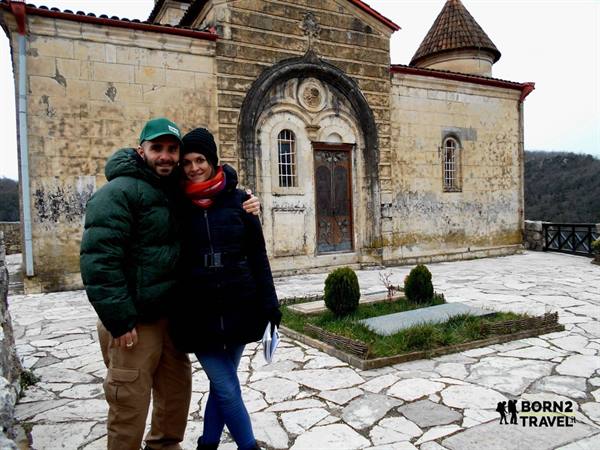
We visit the Church of Jvari; many Orthodox believers are in prayer, making their characteristic sign of the cross, kissing the feet of Jesus Christ on the cross, walking while stroking the base of all the frames of the holy icons. The atmosphere is very solemn and we try to show our utmost respect even when, shortly afterwards, inside the majestic Svetitskhoveli Cathedral, a monk with a long white beard, blessing all the faithful, soaks us completely with a large plume dipped in water… after this holy shower we continue to the Church of Antioki, dating back to the time of Saint Nino, much loved by Georgians.
We return to Tbilisi and wander among the odds and ends of the flea market, among big old Russian women with gold teeth selling old plates or used tea sets or various pots and pans, and tired-looking men with melancholy, unkempt faces showing old Soviet stamps or Red Army military ranks. In the centre, you just have to enter one of a thousand little alleys to encounter the old Tbilisi of the Soviet era. Decaying houses have not yet been renovated, old wooden balconies look as if they are about to fall on your head, and often an ancient Orthodox church appears, a place of worship and gathering for the people. 22.02.2016 Tbilisi (Georgia) [Stefy]: "We reach the hill by cable car, the ticket costs one Lari, and here we are at the Narikala fortress, from which you get a fine view over the city.
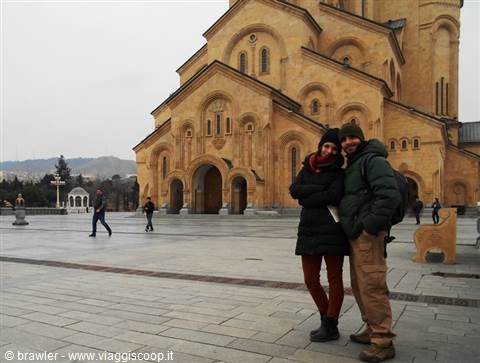
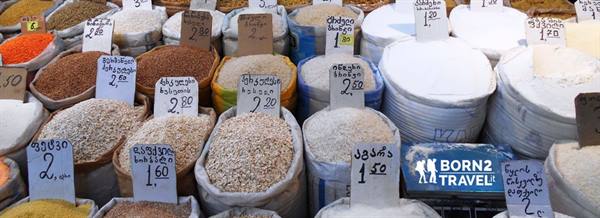
A little further to the right stands one of the capital's most characteristic symbols: the Statue of Kartlis Deda, about 20 metres high and entirely in aluminium. It is a perfect metaphor for the Georgian character: in one hand she holds a cup of wine (hospitality) and in the other a sword (to fight enemies). The Sameba Cathedral, the largest in the Caucasus, is majestic and dominates the whole city! Desertirebis Market. I love markets, they are lively, pulsating places and you can understand a lot about the culture of a place." Aimlessly among the bare stalls selling a little pile of potatoes or carrots or some small, ugly kiwis, these old men and women warmed by tiny wood stoves made me feel so much tenderness...
in that market it felt like taking a step back in time, but two stops on the old Soviet metro, the one with very long escalators that, at high speed, take you deep into the Earth, were enough to change area completely: Rustaveli. Wide clean avenues, shops of all Western brands, expensive cars, well-dressed people… we follow for a while the walking itinerary proposed by our Lonely Planet as far as the beautiful Freedom Square…
23.02.2016 Gori (Georgia)
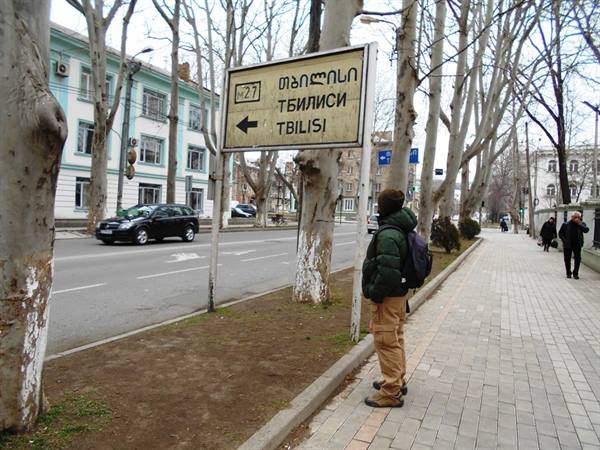
Today we leave the beautiful Georgian capital to enter the heart of this Caucasian country… We calmly cover the 100 km that separate it from Gori, Stalin's birthplace… the landscape is monotonous, flat and desolate… every now and then a camp of containers appears, all identical and in the middle of nowhere: they are the camps of the Ossetian refugees, a region of Georgia, who fled in 2008 because of the Russian bombings… suddenly another area, this time clearly military, is a zone occupied by the Russians… road signs indicate the direction for Sokhumi, the capital of Abkhazia, another occupied land… at times it feels like travelling on the Risk board… Through bare little roads, where vineyards reign — they say the Georgians invented wine — we reach "Atenis Sioni", a very ancient church situated on a bend of the Tana river and surrounded by high hills and cliffs.
It preserves wonderful 11th-century frescoes.
Not far away stands Uplistsikhe, once a gigantic cave city as well as one of the oldest settlements in the Caucasus, and at the height of its development, in the Middle Ages, it counted a population of 20,000 inhabitants! Located along the Silk Road, it boasted about 700 caves carved into the rock; a great city of the past of which only ancient ruins now remain, witnesses to a distant splendour! Gori strikes me from the very start with its shabbiness, its decay and abandonment… it seems to me like one of those little Soviet towns from a Tolstoy novel… sinister decrepit buildings with walls greyed by the smog of these old cars, empty and silent courtyards, sad trees without leaves, even the people seem to reflect the character of the little town… old women with curved backs and a scarf on their heads, dressed in black, hurry along the bare avenues, men with hard faces and garlic breath cha
t beside their cars turned into taxis, wrecks of Ladas are loaded beyond belief… Gori is famous for having given life to the statesman Stalin. Few people have left a historical legacy at once greater and more controversial than this son of a humble shoemaker who led the largest country on the planet for 25 years. Had it not been for the role played by the USSR, Nazi Germany would certainly have won the Second World War. Within a decade he transformed the Soviet Union into a great industrial power, moving from Lenin's plough to nuclear weapons, as Churchill wrote in his autobiography. However, the suffering of millions of people, the gulags, the NKVD (secret police), cannot be forgotten. We have lunch at the "Chinebuli", a little restaurant behind the museum, with an excellent khinkali soup, stuffed with meat or cheese… we love Georgian cuisine!
[ continues on: ]
The journey's photographs
7 photographs · click to open them full screen
0 reader comments