This was a trip within a trip, in the sense of an extraordinary "extra" of a whole week. The destination was actually the Fiji Islands, but a sudden decision led us to take advantage of the rare chance to go to Wallis, today reachable from Nadi with a convenient Air Caledonia flight (return fare of about 240 euro per person - duration an hour and a quarter). We stayed in Mata Utu, in a small hotel booked by phone, the Hotel Moana Hou, clean, spacious rooms with air conditioning, private bathroom and dining room. Pleasant accommodation at about 85 euro per night (prices in Wallis aren't exactly cheap). Excellent little seaside restaurant "Chez Patricia", in the village of Vailala, north of the island (on average 25-30 euro per person for a fish dinner). Also recommended is the restaurant Le Recif, in Mata Utu, where we spent 40 euro per person, of which 26 for an excellent French wine.
To anyone going to Wallis in August, I recommend not missing the religious service in the cathedral of Mata Utu on the day of Ferragosto and the big celebration that follows and lasts the whole day. In Wallis, anyone who is cell-phone-dependent or internet-addicted won't have an easy time; in the story that follows you'll discover more about this lost corner of the world.
Day 112 Aug 2009
Il primo impatto
Wallis and Futuna: there aren't many alternatives for reaching these remote Pacific islands. An overseas territory of France, they have always been off the tourist routes. No ferry; the only option is a plane coming from New Caledonia that stops in Nadi, in Fiji. And it's precisely in Nadi that we buy a flight that in an hour and a quarter propels us into an out-of-this-world place, where mobile phones don't exist, for example.
Hihifo airport, on the island of Wallis, is almost a déjà-vu; it's a bit reminiscent of the one in Tahiti, but smaller and more spartan. It's swarming with islanders, very different from the Melanesians we left behind in Fiji. The people here have Maori features. The large number of fragrant flower necklaces and the hairstyles also bring our memories back to our Polynesian travel experiences.
On the plane, a very comfortable Aircalin jet, there are no tourists, but practically all Wallisians who have sought better fortune in New Caledonia or in Fiji itself.
There's no one from the little hotel we had booked with great difficulty by phone waiting to welcome us; we'll later understand that someone waited for us for a while, but then gave up. Our delay, due to customs formalities and the ever-present forms to fill out, gave us the first difficulty of our stay. "But why didn't you take a taxi?", they'll ask us; or, "You could have phoned the hotel." Well... no taxis in Wallis and the only prehistoric phone existing at the airport gave up the ghost long ago. Fine, we'll pay someone to improvise as a taxi driver! But where's the currency exchange office at the airport? Simply... there isn't one.
While the airport slowly empties of the festive people who came to welcome their wandering relatives and while our neurons focus on what to do, a middle-aged European woman approaches us, who had been on the plane with us, but whom we hadn't noticed before. Even before introducing herself, she asks me what two Italians are doing in Wallis. I hope I won't have to ask myself the same thing:-) French by origin, she has lived in Tahiti and currently works at the University of Waikato, in New Zealand. It's her second trip to Wallis, for a project that has her involved in evaluating an unlikely tourist development of these islands; the "unlikely" is my personal opinion. When I explain to her that we'll start our tour on foot and with our suitcases in tow, she immediately offers to give us a hand, acting as our interpreter.
Thanks to the courtesy—not entirely disinterested—of Marie Rose, we thus manage to reach the hotel, in Mata-Utu, about 6 km south of Hihifo.
Marie Rose is at the airport to deliver a rental car to someone who however missed the flight, and who will arrive on the next one, that is, five days later. We thank Marie Rose by renting the orphaned car and begin to breathe in the magical atmosphere of Wallis.
Even the first encounter with nature brings us back to Polynesia. I'm reminded of the wild Huahine, where I stayed a few years ago. The vegetation is varied and lush, generous with tropical flowers and fruits, and the island has gentle hills covered in green; a panoramic glimpse lets us spot a turquoise lagoon that will, of course, be our next destination. The gardens of the houses are well kept and it's common to hear the lawnmower at work.
In the evening a strong wind rises that will keep us company, along with storm clouds and a few downpours of rain, for the next two days, forcing us to postpone the lagoon tour. We take the opportunity to snoop around Mata-Utu and its surroundings, and to explore the interior of the island.
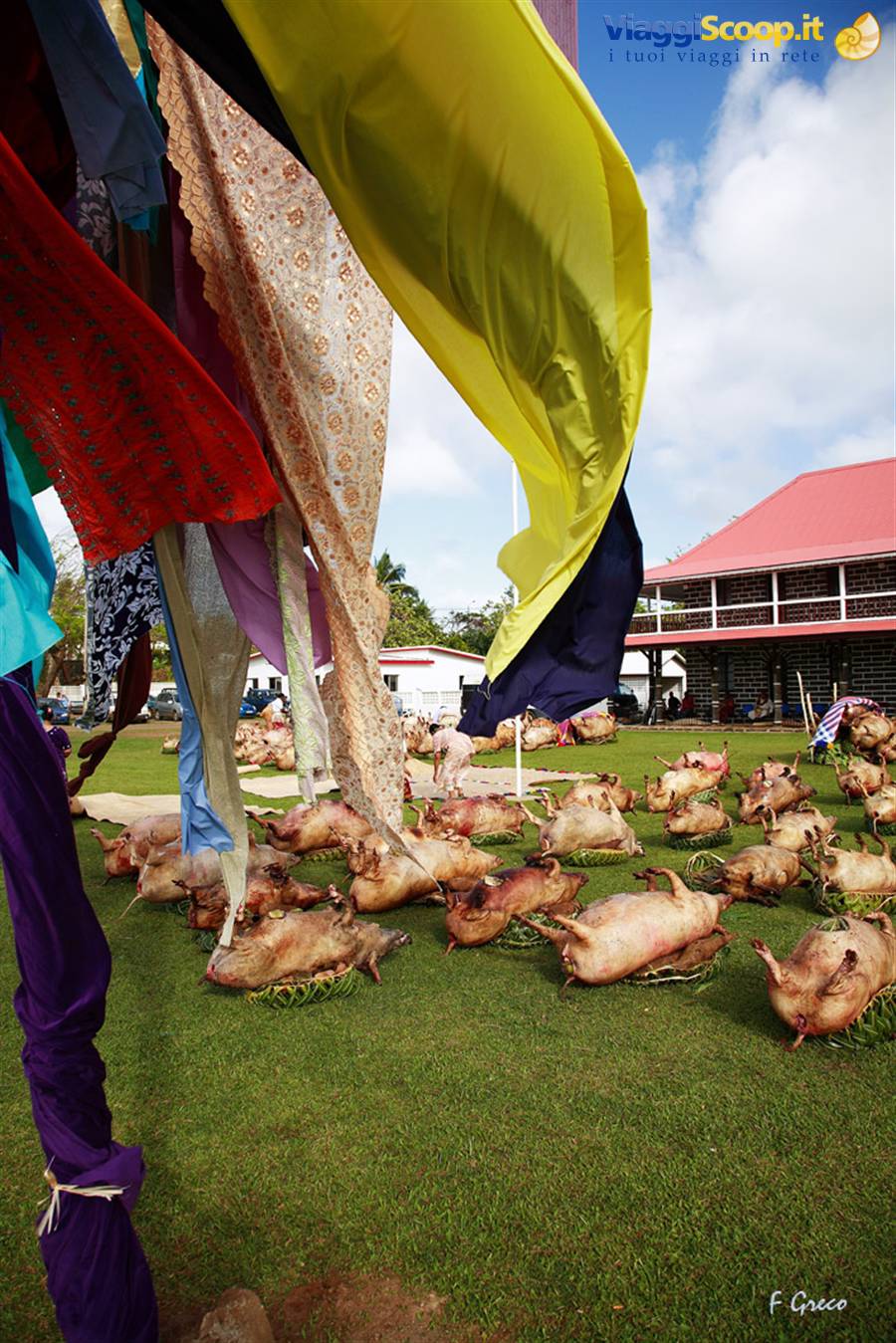
The pigs don't quite agree
Day 213 Aug 2009
Iniziamo l'esplorazione
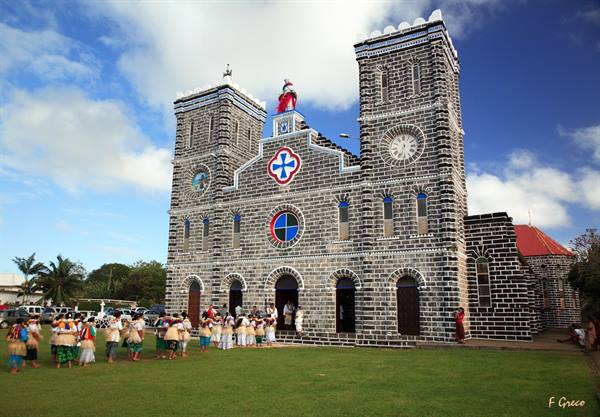
Mata-Utu, the main village with about two thousand inhabitants, houses the royal residence and, right beside it, the imposing colorful cathedral. We immediately discover that the influence of the missionaries has decisively marked the destiny of these people, setting the rhythm of time with Sunday masses and bell tolls, and promoting a regulated and modest lifestyle. The strong sense of modesty leads the Wallisians not to expose more square centimeters of their bodies than necessary: even Bermuda shorts above the knee or a Western-style neckline is pure transgression. Not to mention bikinis! Even the men, despite the often humid and unbearable heat, carefully avoid going shirtless. And all this is true even in the rare moments of local bathing, where you witness the spectacle, common also in other cultures, as in the East, of bathing fully clothed.
Mata-Utu has a few shopping centers, where you can find just about everything, including French wines, classic baguettes, Parma ham and Nutella. The influence of the French residents is also evident in the cuisine, definitely superior to what on average "delighted" our palates in Fiji. On the other hand, rare, malfunctioning and extremely expensive Internet Points give us a measure of how far Wallisian culture still is from ours, now entirely web-oriented. We change 1500 euros into Pacific francs at the only authorized counter, considering that we'll pay the hotel bill in cash; credit cards, needless to say, are not welcome.
We leave the village after a quick snack of an excellent fish soup (Antonella) and a terrible Italian chocolate ice cream (yours truly, being very clever, just to use a euphemism). The interior of the island is lush; nature has run wild, aided by the warm-humid and rainy sub-equatorial climate, covering every available surface with a rich variety of plants. We soon leave the few paved roads to plunge into the jungle, among potholes and sudden mud puddles, heading for a volcanic lake recommended by our Lonely Planet. Marie Rose's Suzuki Vitara handles it brilliantly, even though it shows an age greater than its registration. After a good deal of wandering in search of some sign, we resign ourselves to asking an islander for information, who explains the route to take. Meanwhile, I note with pleasure that my school French is making exponential progress.
Lake Lalolalo appears to us suddenly, spectacular as described in the guide. It's perfectly circular and unreachable on foot, unless you lower yourself thirty meters along the sheer walls, covered, moreover, with very dense vegetation. The landscape captivates us for a while, while a sun hot to the point of merciless peeks out from the clouds that are thinning. The wind, on the other hand, continues insistently, but all in all it's also pleasant. Continuing along the itinerary, we explore the entire west side of the island, which is the wildest and practically uninhabited, stopping now and then for the obligatory photo. We end the day at the top of the highest hill in Wallis, from which you can admire a 360-degree panorama.
In the evening, a fantastic fish salad awaits us at the hotel, served by the two girls who welcomed us at the reception, a little dinner overshadowed only by the ones we'll later enjoy directly under the stars at the charming and renowned seaside restaurant "Chez Patricia".
The Moana Hou hotel is right in front of the lagoon, just outside Mata-Utu, on the little road that runs along the sea. It's actually a family-run guesthouse, but with large and very clean rooms, ceramic floors in bright colors laid out randomly, an air conditioner sufficient to dehumidify the air, a minibar and even a color TV with six tuned channels. Permanent but discreet guests: three geckos, which from sunset onward try to scrounge a dinner of mosquitoes; Antonella reluctantly had to give up her privacy, but then she got used to it. Nothing to say about the service: they changed towels and sheets every day for the whole week. All the family members are kind, but at the same time reserved and shy. We would have expected at least a minimum of curiosity on their part, I don't know, some questions about us, about our country of origin, about our work.
Who knows, their shyness in dealings with foreigners may perhaps be due to the fact that they deal with only a couple of tourists a year and a few French people on work assignments. Or rather it's simply an attitude intrinsic to their culture.
The feast of 15 August
Day 314 Aug 2009
...continua l'esplorazione
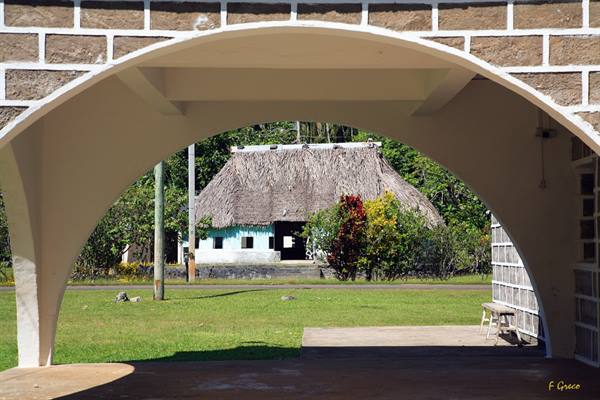
The following day sees us still wandering around waiting for better weather. We take the opportunity to visit the east side of the island, where there are some fale, traditional cool and airy dwellings, and some imposing churches that rival the cathedral. It's not raining, now and then the sun peeks out and floods us with warmth, but the wind is still dominant. It suddenly stops the next day, as predicted by the Fijian "meteorologist" who sells cold drinks thirty meters from the hotel.
Dream lagoon
Day 415 Aug 2009
Il giorno della festa
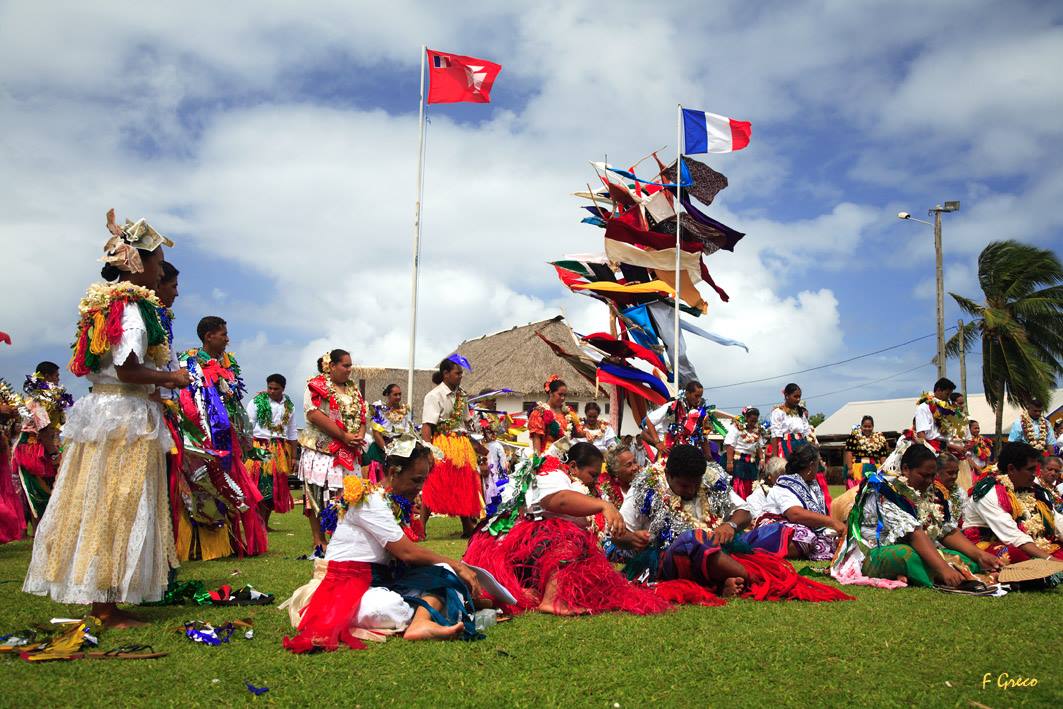
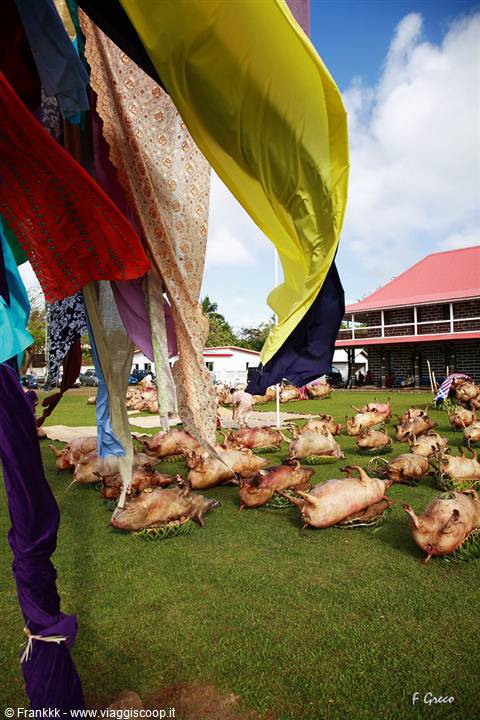
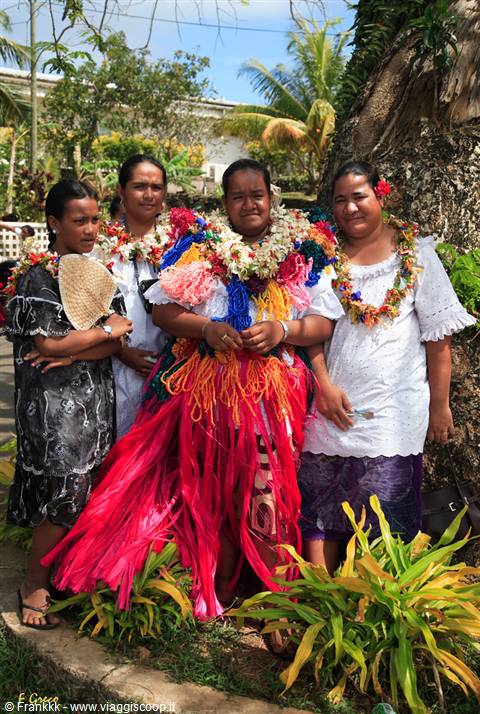
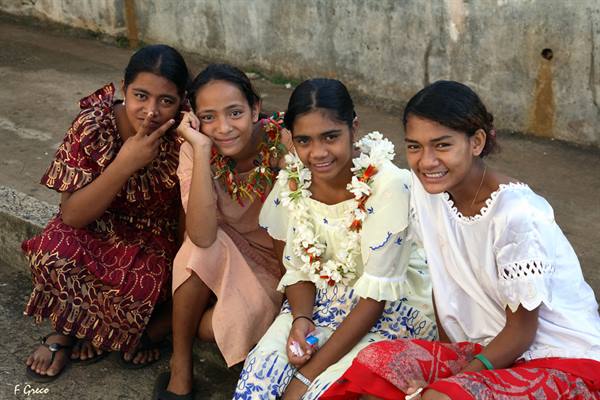
Saturday, August 15, the day of the Assumption, in Wallis is a public holiday in every respect. Forewarned by the hotel owners, we get up early to be at the cathedral at seven o'clock sharp for the start of the religious service. The day is clear and promises to be decidedly hot from the early morning hours. In church I can only last ten minutes; even the Wallisians, who should be used to it, fan themselves shamelessly. The spectacle of the islanders dressed in their Sunday best is nothing short of choreographic: clothes in a thousand colors, fluttering strips of colored tinfoil, elaborate hairstyles, fanciful hair clips and countless flower necklaces fill our photos and video footage; young girls kept in formation by a grumpy elder make their entrance into the church during the ceremony. But the best is yet to come.
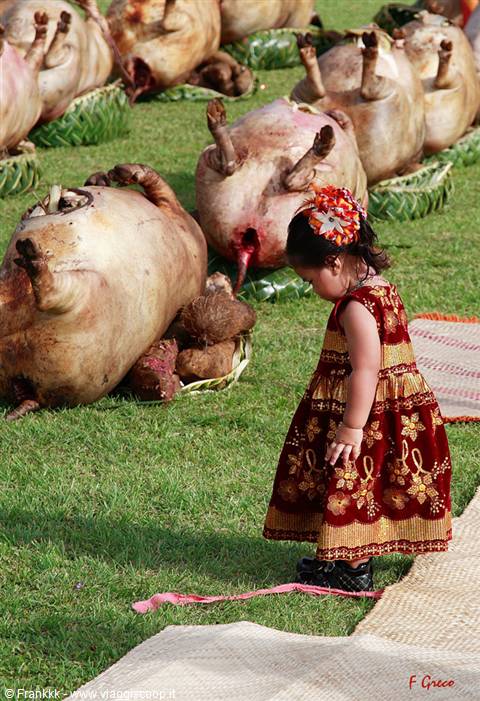
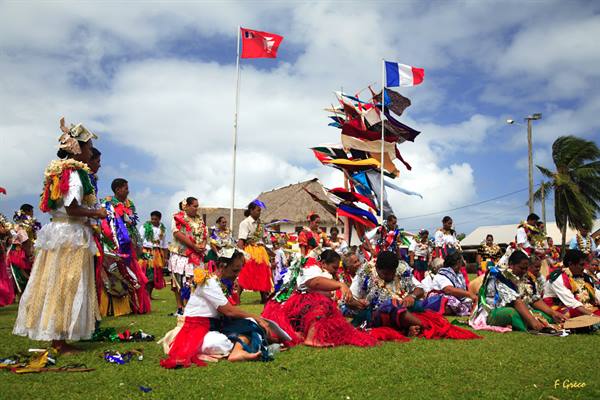
It's customary that every year, on this very day, a show of dances and songs is staged in the square in front of the royal residence. The dancers come from six different villages, including the remote Futuna, and perform at different times until sunset. The show is preceded by an exhibition of more than a hundred pigs sacrificed for the occasion, which are donated by their respective owners to other families, generally needier ones. It's a way of thanking someone, but above all of redistributing resources so as to reduce the differences in living standards between the well-off and the less well-off. In a nearby venue, large enough, a mega breakfast has meanwhile been set up and is offered free of charge to visitors.
We too, now fully caught up in the festive atmosphere, have something, in the company of the French academic we met at the airport (and who, for her research, will interview us the day before departure). It's right outside the venue, while I treat myself to a cigarette, that I make the acquaintance of a Frenchman who has just arrived. Out of curiosity I ask him what his stops were before landing in Wallis and I discover that he left Marseille 4 years ago on a small sailboat, now moored in the lagoon. What incredible envy! Why is it always others who make my dream wishes come true?
Finally, after the traditional kava preparation ritual, already tasted during our stay in Fiji, the dances begin, accompanied by chanting choruses and with the passionate participation of a group of local musicians. The king and his courtiers also watch the show from the front row, but comfortably protected from possible sunstroke. Some elderly women are seated in orderly rows, under the scorching sun, surrounded by the costumed dancers arranged in a semicircle, and gently move their torsos and arms to the rhythm; some people in the audience tuck banknotes, even large denominations, into their décolleté or among their hair. These gestures too are partly aimed at redistributing economic resources for the benefit of the poorest. After a few hours, gratified by the folklore and worn out by the heat, we set about organizing the following day. The weather is good: the lagoon awaits us.
Turquoise
Day 516 Aug 2009
Dal 16 al 18 agosto: tre giorni da sogno
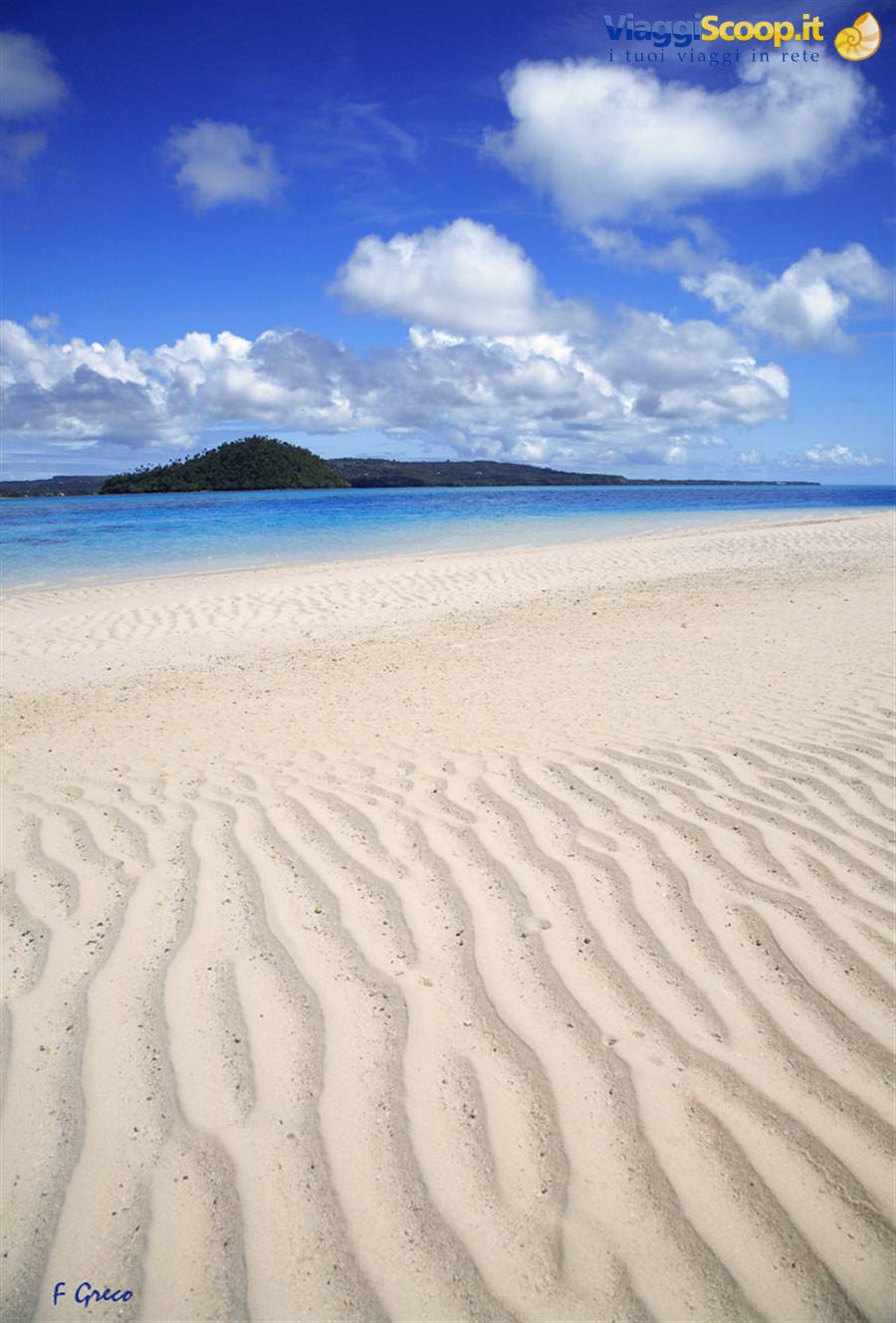
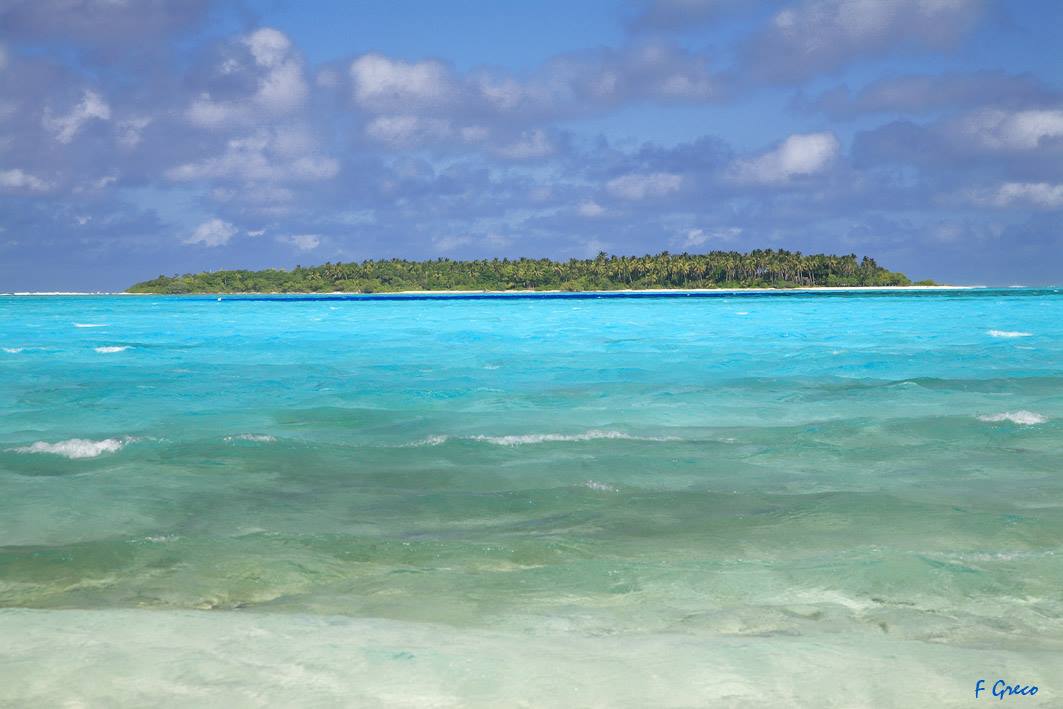
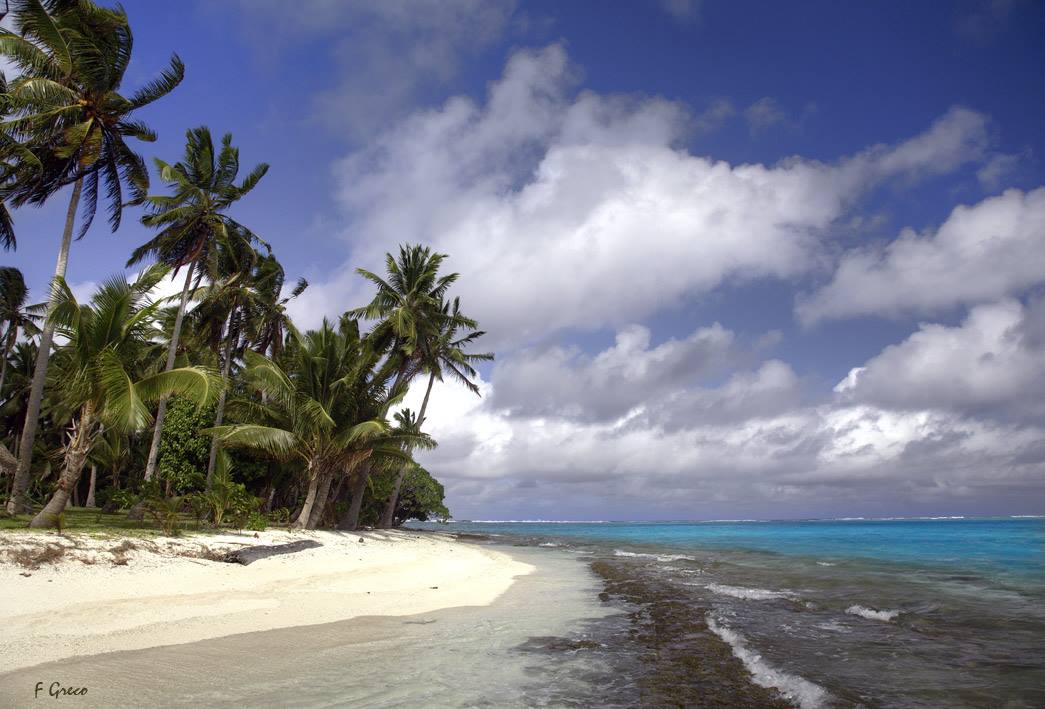
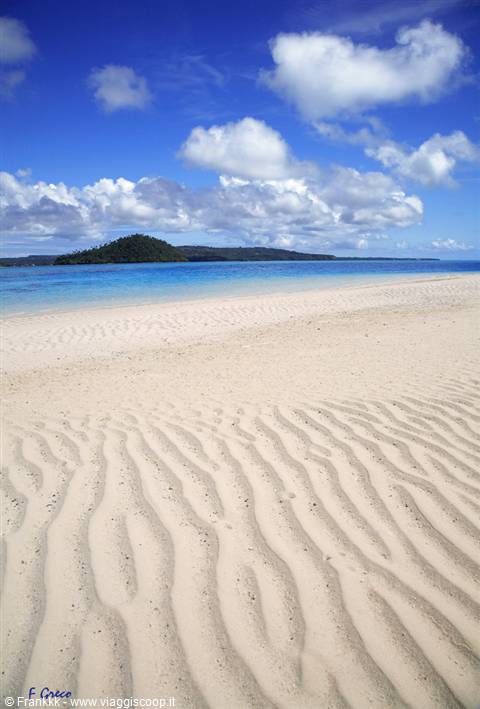
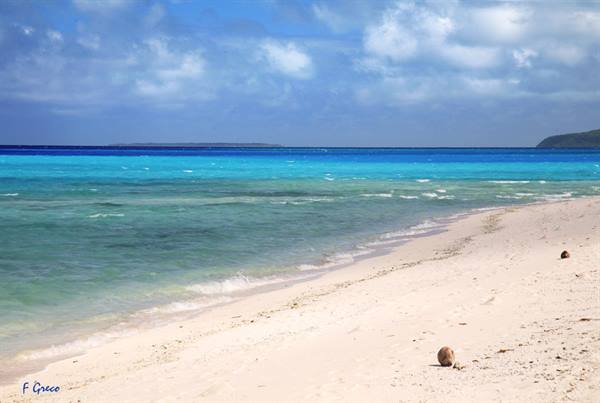
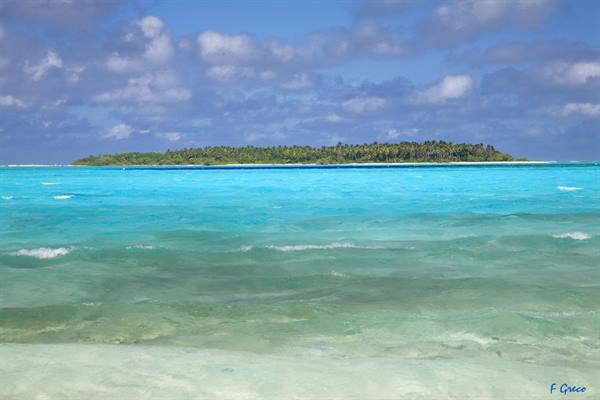
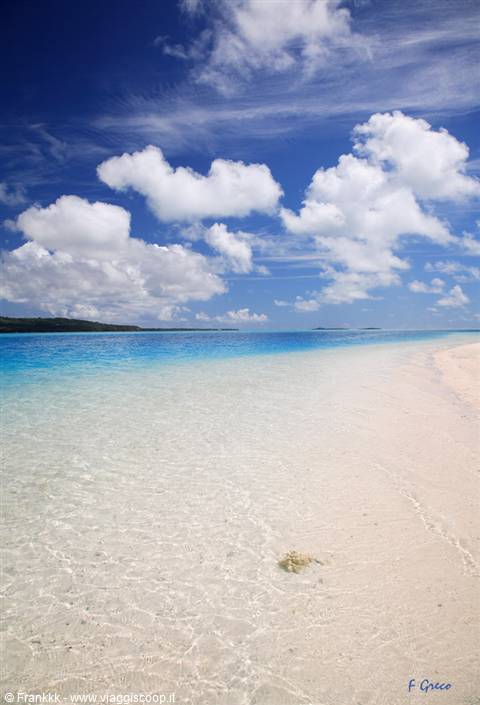
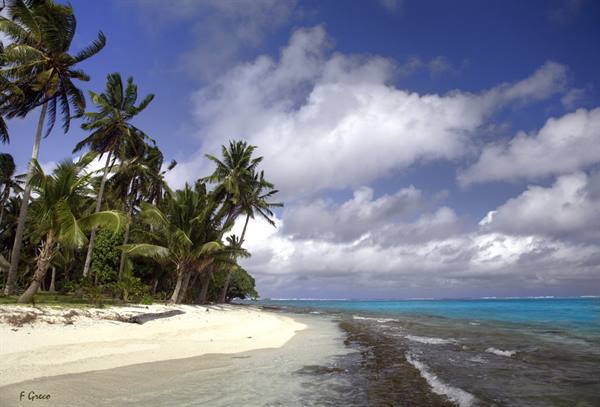
Wallis has no beaches; otherwise it's the classic island with a lagoon dotted with volcanic or sandy islets close to the coral reef. The tide phenomenon is particularly evident, perhaps more than in Fiji, forcing you to plan boat trips. However, even during low tide it's sometimes possible to move by sea, but after walking 50-100 meters in the water to reach a strategically moored boat. My advice is to get moving early in the morning, preferably at low tide, since banks of candid coral sand emerge which, together with the coconut palms, tailor-make a picture-postcard landscape setting.
And it's precisely this setting that characterizes the next three days, the last of our vacation in the Pacific: leave in the morning by boat, spend the whole day on a deserted island, absolute masters of the white-sand beaches, swim in a warm and crystal-clear sea, with mask and fins in tow to explore the splendid coral seabeds, get drunk on the colors of the lagoon, shifting from light green to turquoise and deep blue, relive all these traumatic experiences immediately after a well-deserved packed lunch, read a book under a palm tree while the high tide rises, sunbathe in a decidedly all-over way caressed by the afternoon breeze...
well, I won't go on! I think to this daytime picture, for completeness of treatment, one can only add the charm of romantic walks by the light of the galaxies of the southern hemisphere, under a sky darker than black, which on the last night grants us a shooting star, just in time to make the wish to set off again soon toward a new destination.
0 reader comments