I visited the state of Bahia on the occasion of a Tour made in the company of a friend from Perugia. During the trip to Brazil we crossed into Paraguay and Argentina. We reached Brazil on a flight of the Portuguese flag carrier TAP from Rome Fiumicino to Lisbon in Portugal, and from there to Salvador de Bahia. We left the state of Bahia on a flight of the Brazilian airline GOL from Salvador de Bahia to São Paulo.
Day 118 Jan 1996
Arrival in Salvador
Our first contact with Brazil is late in the evening when we land at Salvador de Bahia Airport. Once the easy and quick customs formalities are done, we find waiting for us the taxi we booked through the hotel where we will be staying. We arrive at the Biribiri, where we have taken accommodation. From the outside it looks like any old tenement building, but the inside is even more bare and sad. I don't have great demands when it comes to lodging, but this is really the bare minimum. The owner, however, is Italian and we are counting on getting tips from him for the coming days. The room mirrors the rest of the establishment and on top of that has a window that cannot be closed. We are worried not so much about the dreaded Zika mosquitoes as about the possibility of theft, since many guides describe Salvador as the most dangerous city in Brazil.
My travel companion would like to change hotels, but we have already paid a deposit from Italy, we are tired and, above all, it is late, so it doesn't take us long to fall asleep. Air conditioning nowhere in sight and the TV works intermittently. We are very disappointed with this accommodation because we do not yet know that behind this run-down appearance lie merits for which we will undoubtedly end up wholeheartedly recommending it.
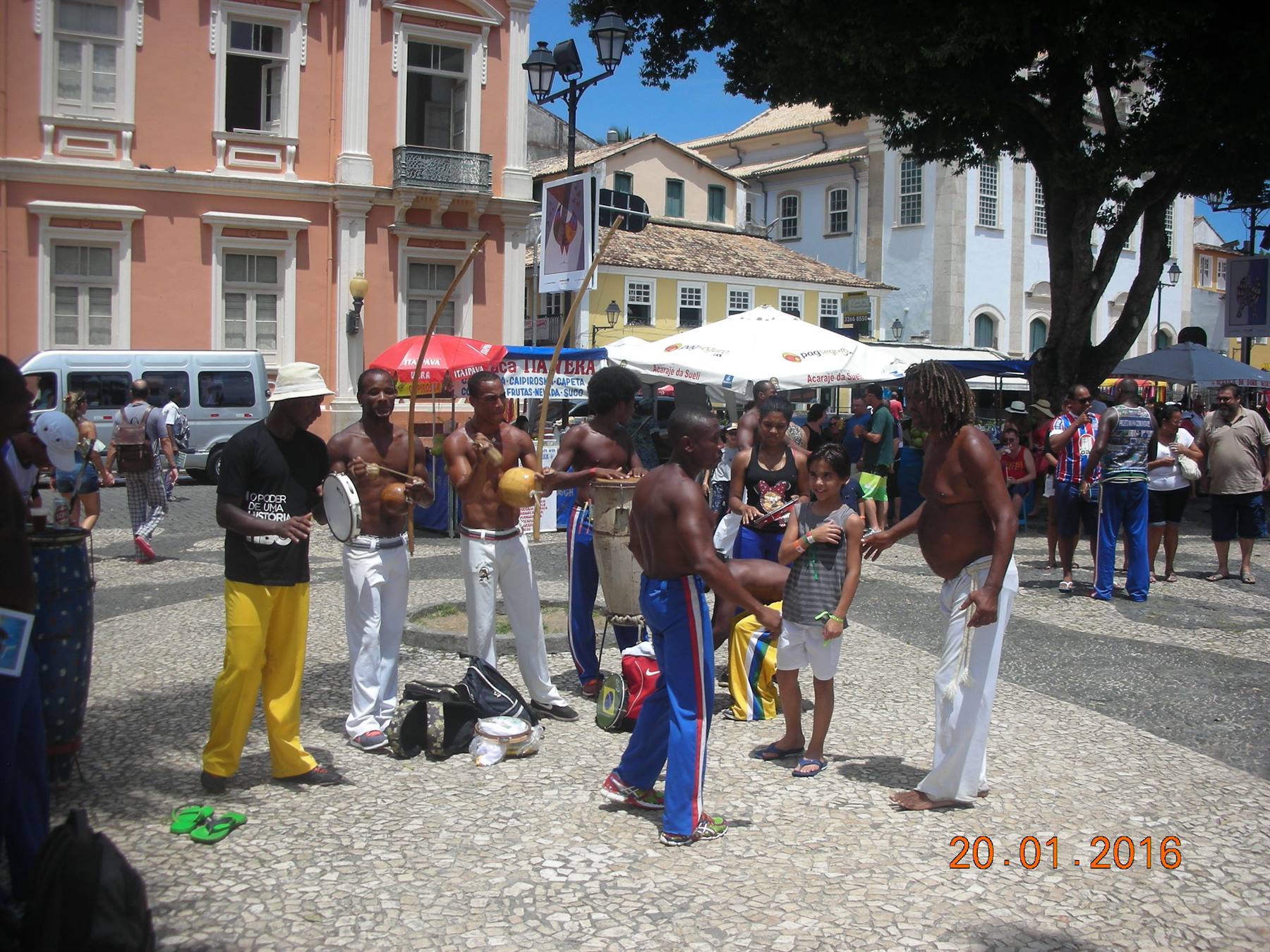
La Capoeira
Day 219 Jan 1996
Breakfast is not included, but the young hotelier takes us to the very nearby market where we find a snack to put under our teeth. He would like to pay for it himself but we refuse. He gave us a map of the city highlighting the most interesting areas and explained the route to reach the historic centre. It seemed like being in the extreme outskirts given the dilapidated structures of the buildings and the disorder, yet we are below the hill that houses the main attractions. Walking up an alley that branches off from the street of our accommodation, we arrive at a small square from which a first glimpse opens onto the Bay of All Saints and the Port. A long walk leads us to the nerve centre of Salvador, the Pelourinho, a vast cobbled open space that develops uphill, taking on a funnel shape. It is the entrance to the old city, the oldest in the Country and the first Capital.
The place is very touristy, with the characteristic stout ladies in their wide skirts and a kind of turban on their heads, those who read the future from hands, street food stalls, street artists and numerous souvenir shops. It is certainly a lively city despite the old architecture. There are many Churches that for centuries comforted both the rich Portuguese colonizers and the slaves forcibly immigrated from Africa after their liberation. From the black Continent they brought with them culture and tradition, merging it with the Lusitanian one and giving rise to a particular style that has produced dances and rites such as capoeira. The latter is a dance that reproduces combat using mainly the legs; you can see it walking through the streets and squares of Salvador, accompanied by the rhythm of drums.
Catholicism too has been strongly influenced by this style and bent to pagan rites that gave life to religious syncretism. The culture of Salvador then expanded into other regions of Brazil, becoming a distinctive mark of this immense Country. The Piazza da Se offers a fine panoramic view of the Bay below. By lift we leave the historic centre, made up entirely of colonial houses and Churches, and descend to the covered market, used almost exclusively by the tourists unloaded in masses from the nearby cruise ship dock. We try to reach a small beach near the city by bus without succeeding, however. We are going in the opposite direction, so we get off and, having taken a taxi, have ourselves driven there. The long beach is bordered by a wide pedestrian seafront promenade walked by my travel companion while I, sitting on a rock, watch the Atlantic Ocean break on the shoreline.
By taxi we return to the lift and by it to the historic centre, which meanwhile has come alive with numerous tourists. We find a place in the restaurant recommended by the owner of the Biribiri. Indeed we like it there, fixed price for an unlimited buffet lunch. Fortunately this morning, as soon as we arrived in the centre, we changed money inside a clothing shop. With a long walk we return to our accommodation to rest during the hottest hours. In the evening we meet the partner of the Hotel owner, also Italian. By taxi we return to the historic centre where a festival is taking place, there is a large street food area which we take advantage of while a musical group performs on a stage. A sudden din announces the masked parade in which the local samba schools compete with one another. There are big papier-mâché masks reminiscent of the isolated masks of the Viareggio Carnival.
The intense rhythm of the drums accompanies the march. We follow them through the alleys that pass among the colonial houses and in front of the samba schools. Many people have come out into the street. After listening to a few numbers by the artists on the stage, we come down from the Pelourinho and take a taxi to the Hotel, where we spend the night.
La Capoeira
Day 320 Jan 1996
From Salvador to Praia do Forte
In the morning the owner of the Biribiri was supposed to take us to the bus station, which is outside the city centre, but unfortunately his car is at the mechanic's. He books us a taxi that takes us to the station. The place is very large because this is the terminus for the main lines in the State of Bahia; moreover, the buses that make long journeys to every corner of Brazil stop here. Having easily found the ticket office of the Green Line Company, we are given an electronic card with which we reach the gate. While waiting we have breakfast in a fast food place, drinking the first coffee of the trip. Brazil is notoriously the home of coffee, but producing it does not mean knowing how to brew and roast it, and indeed this will be the first of only two attempts, after which I will give up drinking it until I return to Italy.
Everyone has their own tastes, but for me Brazilian coffee is one of the worst I have ever drunk. The bus leaves and in about an hour we are in Praia do Forte. There are many seaside resorts both north and south of Salvador, but looking at videos on youtube I chose this one, which also features the leading one among the numerous marine turtle breeding centres. From the bus stop you walk along a long pedestrian avenue lined with shops, restaurants, cafés, travel agencies. The walk ends in front of a small beach surrounded by palms near a very white church on which the sun reflects, and a few steps from the entrance of the Turtle Centre. Our accommodation, however, is on a parallel street. The establishment is nice, very youthful, but the staff do not seem very prepared to respond to our needs.
The room overlooks an internal courtyard and gives off an unpleasant smell that we will manage to partially mask by spraying deodorant. Moreover, the smell is quite noticeable when we enter, but as time passes we no longer perceive it. When my friend goes to the reception to pay, he realizes that he left his credit card and cash under the pillow at the Biribiri. We immediately think that if they have remade the room it has already been found, and the Biribiri is an hour away from here. We have no choice but to telephone Salvador and hope for the honesty of whoever answers. And lo and behold, not only does the hotel owner go to the room and find the money, but he brings it directly to us in Praia do Forte, an unexpected gesture of the greatest honesty. For this reason, despite some inconvenience, I am happy to recommend the Biribiri.
Certainly it is not accommodation for demanding people, but it is perfectly suited to young people who want to spend little. Grateful to the owner, if we ever return to Salvador we would not hesitate to book at the Biribiri. Having solved the problem, we go to the small beach near the Church, where I immerse myself in the sea and take a long walk as far as beyond the fence of the Turtle Centre. From there begins a very long beach that stretches as far as the eye can see, all lined with palms. For now I limit myself to looking at it from there. Back at the small beach I watch the boys playing volleyball, others trying to keep their balance on a rope tied between two palms, and some young women sunbathing. I buy a coconut from a stall; the attendant opens it with a sharp blow of his machete and inserts a straw. The milk is abundant, fresh, delicate, the taste pleasant.
In other places in the World I have not tried it, but here, where everything is clean and tidy, where the people who frequent the place are dressed Western-style like me, I trust myself to drink it. To be precise, once in Italy I had drunk it packaged in a can but I didn't like it. My travel companion returns to the Hotel to wait for the boy from Salvador with the money, I stay on the small beach and go back later when the sun gets too hot. There isn't much to do in this place other than relax. Later we stroll along the pedestrian Avenue, eat an artisanal coconut sorbet and wait for the sunset on the small beach. For dinner we go to a restaurant, sitting outside in the hope of not being bitten by mosquitoes. We set off from Italy with the few comforting facts about Zika. A final walk along the avenue to aid digestion, then we return to the hotel for the night.
We had the idea of booking an excursion for the day to a rather distant locality where you can ride the dunes, but we gave up because the forecast calls for rain.
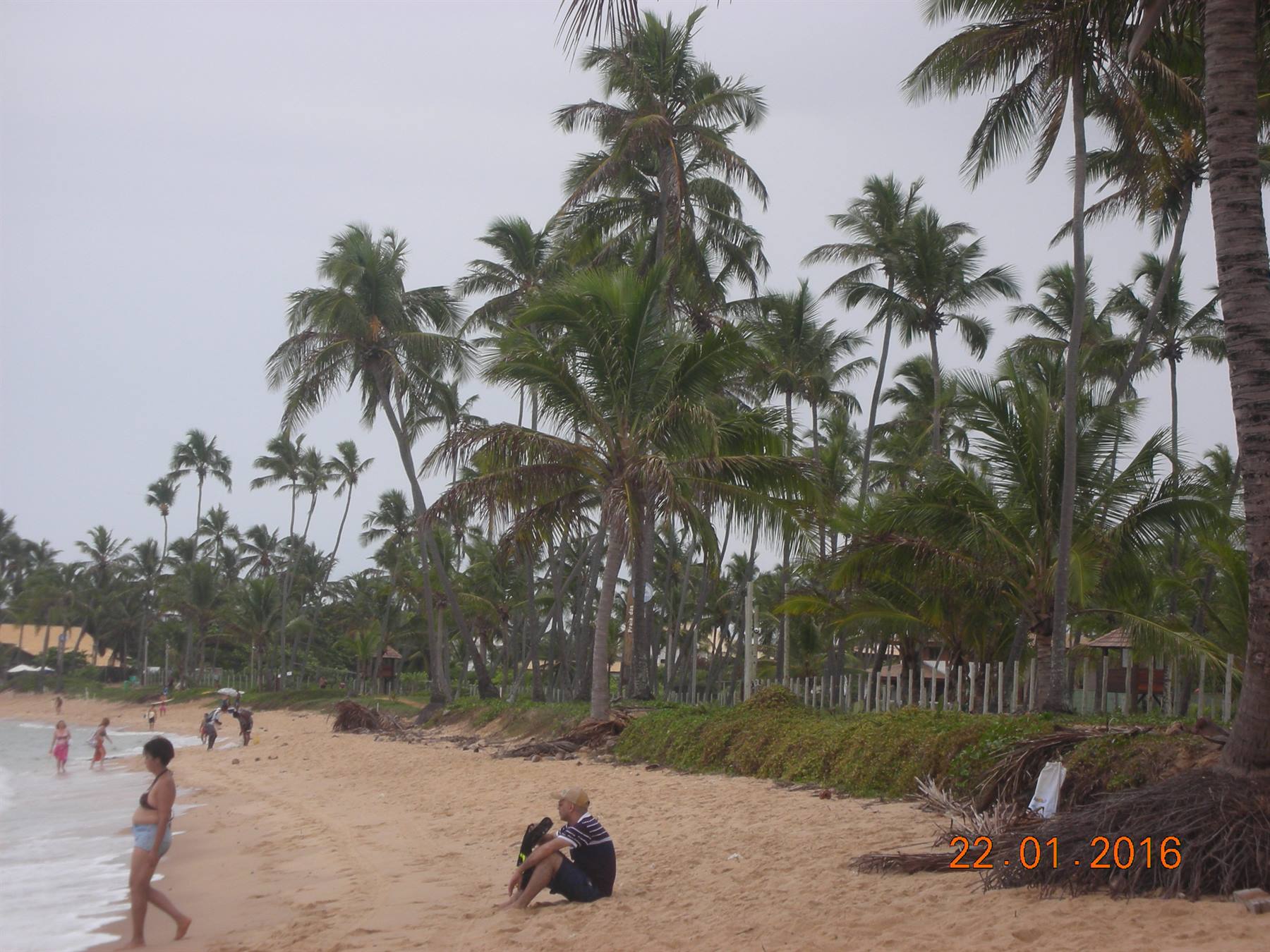
Praia do Forte beach
Day 421 Jan 1996
Praia do Forte
During the night it rains steadily, but in the morning it stops and only the clouds remain. We take a long walk on the beach beyond the Turtle Centre, a strip of sand that stretches as far as the eye can see, lined with palms. A classic tropical setting with a sea subject to the phenomenon of low tide, which exposes the rocky intertidal zone whose numerous depressions have trapped the water. Despite the grey day I take a swim in which I even hurt a finger that hits a rock. On the way back we stop at a small equipped area with deckchairs and umbrellas to buy from a street vendor the cheese sticks toasted on the embers that we had seen, curious, in Salvador — nothing special. Meanwhile the day has straightened out and the sun has come out.
We take a secondary pedestrian path that, with a roundabout route making us circle around elegant resorts, brings us to the main street from where the pedestrian walk to return to the small beach near the little white Church begins. Having given up the excursion to the dunes, we don't have much to do; we sit in an ice cream parlour, drink some coconut milk and try to pass the time relaxing between our room and the commercial area. We have spotted an Italian Restaurant and without hesitation we go there. Good and abundant food. A couple of steps along the pedestrian street and then to bed..
Praia do Forte beach
Day 522 Jan 1996
Departure from the State of Bahia
It is early morning when the taxi we booked the night before at reception takes us in about an hour to Salvador Airport, which fortunately is on the northern side of the city. From here we take the plane to São Paulo's domestic flights airport, where we will catch a connecting flight to Foz Iguazu (for which I refer you to the PARANÁ itinerary). On the first day in Praia do Forte I forgot to mention—so I'll do it now—that we visited the turtle breeding centre. It is a not very large area located just after the white church, accessible with an entrance ticket that supports the centre itself. Inside, which doesn't merit more than an hour, are tanks with turtles of various sizes. The visit can be very nice for children. The turtles breed on the nearby beach, where while walking we saw posts with a sign identifying the breeding areas.
Centres like this exist in various points along the Brazilian coast, but this one seems to be the most important.
0 reader comments